Archives

Ingress no more

Somewhere in Geneva For months I was passionate about Ingress. I was passionate about the game until fuel costs, parking costs, device costs and time costs were too high. When you play from level one to eight the game is fun. You progress quickly and you meet new people. You discover new places and it’s enjoyable. As you reach level 8 and above the game becomes more like a chore. You have to walk hundreds of kilometres and you need to perform tens of thousands of actions to progress anymore. Every medal takes time. This time, when you drive from the countryside to a town or city is money. Imagine doing something different. Imagine writing or taking pictures. Imagine reading current affairs articles or donating time to an event or charity. Imagine what you could walk away with. Imagine what achievements you could tell people about. The biggest waste of time with the game of Ingress is farming. Farming in the game refers to hacking portals to get weapons, mods, shields and more. I find farming to be the most boring and tedious part of the game. You spend two or three hours farming and within twenty minutes your stock is empty. Imagine if you had used that time to go for an energetic bike ride.
Bragi - self contained in ear audio player

BRAGI - The Dash – Wireless Smart In Ear Headphones from BRAGI on Vimeo. I enjoy cycling, running, climbing and via Ferrata so this type of device is well suited to my needs. The price is not. At 300 USD it is an iPod shuffle replacement at its core. From what I understand The Dash can track steps, heart rate and duration of sports so in theory you can go without a sports watch, sports tracker or mobile phone. In practice, I never leave the house without my phone. I do see it filling a swimming niche. Most mobile phones are not IP68 certified. If this device is IP 68 certified (I could not find information on the website) then I see it being especially interesting for swimmers. According to their website they can be used for four hours in between charges but charge time is two hours. They will last through most workouts. The limitations I see to this device are first and foremost the price. I don’t want to pay 300 USD for something that I am likely to lose. I listen to podcasts and audio books and like to have several on my devices at all times. Both my mobile phone and iPod classic fill these roles with ease. When the price for these devices descends to 200 USD I will be willing to buy a set. I would also like to have either two sets of earphones or a charge time of just an hour rather than two. They say that the app is coming soon. As an audiobook and podcast listener, I want to save my progress and bookmark interesting passages. I would like to see this incorporated to the gestures that control the device.

StravistiX for Strava

StravistiX for Strava

Stravistix for strava is a Chrome plugin. It allows you to analyse the data from your ride in more detail and with more graphs. In the detailed view you can see heart rate information, speed, power, grade, elevation and  ascent speed. It allows you to see each metric in more depth. It allows you to look at your statistics in detail. You can see what percentage of the ride was flat, uphill or downhill. You can see how fast you were climbing and how your speed varies. [gallery columns=“4” ids=“2707,2708,2709,2710,2711,2712,2713”] This breadth of data is fun to play with. It allows you to see whether you do spend as much time as you thought climbing. It also allows you to see how much of your time was spent static or moving. There is a weather module for wind, temperature, clouds and humidity. This is a nice way of checking whether the wind is favourable to the ride you are thinking of doing that day. What I would like to see next is a log of the weather and especially wind during the ride. It would like to see ground speed in contrast to wind speed. This data should be relatively easy to acquire. Plugins are great because they allow you to do more with the data that you or other people generate. They allow weekend and professional riders to analyse how they are progressing. It also allows riders to compare themselves with others.

Conversational Social Networks

Ben Thomspon wrote, “How Facebook Squashed Twitter”.  The article looks at social networks from a marketing point of view. I like conversational social networks. Social networks by their very name are for conversations. They are about connections and they are about friendship, collaboration and more. 

In its Golden age twitter was a social network to establish new friendships with people we had yet to meet. It was a great tool, especially in places like London where the community of users was big enough to be interesting. Facebook, on the other hand, was a network of school friends, university friends and eventually colleagues. Facebook was more of an interactive yearbook.

Virtual reality and Dining

The history of entertainment is a long one. We have gone from banquet entertainment during Roman and Medieval times. We have had radio and television to entertain us. We have also had books, magazines and kindles. The idea of Virtual Reality and dinner is not that strange. What is fascinating about Virtual reality is that in our lifetime it has gone from requiring massive computers and cumbersome devices. Today virtual reality can be experienced with a mobile phone. The technology has shrunk and become affordable to such an extent that restaurants want to take theme restaurants from décor, painted walls and location to virtual reality.

Suunto and Sports tracker collaborate.

I have been using sports tracker for years. I first used it on the Nokia N95 8GB several years ago. This was an excellent app that allowed you to track your moves using the mobile phone as a GPS. The limitation of such an app was battery life on mobile phones. The battery usually did not last more than an hour at first and eventually progressed to two hours or more. The first Suunto Device I used was for diving. I used the Suunto D9 dive computer for many months before upgrading. As I satisfied with this device I bought the Suunto Ambit 2 and eventually the Suunto Ambit 3. The reason for buying these watches is battery life. As normal watches they can last for 100 days, losing about one percent a day. If you use them as fitness watches then they easily last for a day or more. When you’re doing via Ferrata, hiking, cycling or doing other sports you want the device you use to track your fitness efforts for as long as you’re going. That’s where Sports trackers and other mobile phones had their weakness. Mobile phone apps sometimes crash. If you’re pushing yourself hard during a workout you do not want to reach the end of a workout with no data. Another frustration I often encountered was with Movescount, Suunto’s social sports app. At the end of quite a few workouts, I was unable to sync my workout data and analyse my progress. At the time, I wanted to see Suunto and Sports tracker combined. They’re both Finnish companies and they both excel at specific tasks. Suunto for the hardware and Sports tracker for the analytics. By combining the two we have the best of both worlds. Communications between Movescount and Sports tracker has been available for several weeks at this point and it works flawlessly. I have hiked, cycled, walked, sailed and climbed and each activity has synced without problems. [gallery ids=“2690,2689,2688”]

Cycling in Winter

After cycling over 1100 kilometres in 2015, I aim to cycle 1200 kilometres in 2016. This goal is an easy one to achieve. It’s the 21st of January and I already have 100 kilometres logged. The weather over the last three weeks has been cold and wet. We have had rain almost every day and it recently turned to snow. As there is a lack of good weather there is no choice but to go out in the bad weather. Cycling in these conditions is messy. Your clothes get soaked from the rain and as I cycle in the countryside I come home covered in mud. When I get home I change into dry clothes and I recover quickly. Rain is easy to deal with once you’re ready to feel wet and dress for the cold. What is more challenging is cycling on slick tires on snow. Some of the roads I cycle on are salted and cleared but as I also use agricultural roads they are covered in snow. Safety takes focus and concentration. The rear wheel skids if you apply too much force to the pedal and the bike can skew if you are not careful. Cycling in such conditions is not ideal. It demands resistance to the cold, stamina to continue making the effort and determination to set an achievable goal. I will continue towards 200 kilometres by the end of February. Cycling consistently now will make summer all the more pleasant and rewarding.

On the Potential of Self-Driving Cars

When people write about self-driving cars they write from the perspective of people living in cities. I live in the Swiss countryside at the foot of the Jura which results in me seeing the potential of self-driving cars differently. For a start at the moment buses operate from 5 in the morning to 9 in the afternoon. There is a tow hour gap at lunchtime when there is no service and at other times the frequency is once an hour, except at rush hour. When self-driving cars are available I see the bus and taxi services being discontinued. I also see the space dedicated to parking in cities vanishing. I see cars being used to connect villages to town. You get into the self-driven car and it takes you to the train station. From the train station in Nyon you get to Geneva or Lausanne. From Geneva or Lausanne you have trains and buses to take you to your final destination if you are either recovering from an injury or carrying too much weight. Scuba diving and winter sports require a lot of gear so a self-driven car would be helpful. I also see self-driving cars as being great for teenagers living in the countryside. Self-driving cars will provide a 24 hour per day transportation. This means that teenagers will be able to take the last train home and catching a self-driven car from the train station to home. I see this as being just as useful for grown ups who like to have more than one drink when out socialising with friends. For now society believe in designated drivers. With self-driving cars the designated driver will be a thing of the past. The train will transport you from the train station to your home. It will also provide country bumpkins with the opportunity to stay out even after the last train. It will equalise city slickers and country bumpkins. On weekends when groups meet up to do activities self-driving cars will be of great use. At the moment when you hike or do Via Ferrata there is a need for wide open spaces where cars can be parked and sit for hours. Self-driving cars would bring people to the hiking or via Ferrata base and drop people off. These cars will be able to return to active use in the region until activity participants return to the starting point ready to return home. Car ownership would be replaced by car allocation. For now when cars are not used they are parked and space is used for them to get in and out of that parking space. Space is also needed for the car driver and passengers to get in. When cars drive themselves that space will no longer be needed. Car will be parked as they are on ferries. Only a few centimeters are left between cars and unloading is one row or row at a time. Parking could be designed to maximise space and efficiency. Mobile phones and smart watches can also be used to increase efficiency at rush hour. When two or more people are heading from the same train station to the same village their smart devices will see this and allocate a parking bay or vehicle with a display to show the name of the destination village. For now the limitation with buses is that they have a set route. If you are at the end of the route you have to wait for everyone to be dropped off and this can add minutes to your journey time. Self-driven cars you would be routed straight to your village square and walk from there. The point of self-driving cars would be to minimise waiting times. Rather than wait from half an hour to an hour for a bus you would be taken home within 10 minutes of arriving at the train station. Cities and traffic lights today are designed for human drivers, whether for trams, buses, cars, cyclists, pedestrians or motorbikes. In the self-driven future we could do away with traffic lights. Traffic flow in cities will be reduced because trains and public transport will make it easy and convenient to get from point A to point B. In a city like Geneva where the system is nodal from the centre out we would have private transport to go between distances where a 15-minute walk is needed. The point is to reduce the need for people to go from the periphery to the centre and then back out to the periphery. The point of self-driving cars would be to maximise network efficiency and provide people with a smooth and efficient way to commute and participate in social activities. It should equalise life for city slickers and country bumpkins. The purpose of self-driven cars should be to maximise use of the existing infrastructure whilst making the last mile more convenient and flexible.

La Grotte Aux Fées - second trip

15A Cave exploration is really fun. You go from an autumn day, lie down and pull yourself forwards with your elbows and push yourself with your feet. You turn your head sideways so that it fits through. The gravel moves under your hands and body and eventually you are through in to a large chamber. You can duck waddle from this tunnel to another chamber. You get to a pile of rocks and you look around until you find a path where you can cross. You angle your body one way, and then the other. You lift yourself with your arms and you clamber in to another chamber. This one has a tall roof and pitons in the wall where climbers have come, before you. From here you go sideways and back down through rockfall and squeeze through. As you squeeze through you come in to another chamber. This one is shaped like an eye. You crawl along this one. Sometimes you go through gravel and dirt. As you do this you get wet and dirty. You try to avoid puddles but still your clothes get wet. Luckily at this point you are not cold. This segment is where I was most uncomfortable. As I have only been in this cave once before I was not certain of where I was going. I was also lying down in pebbles and silt. This cave floods when it rains. I was uncomfortable because of the amount of rock fall. It had probably been around there last time but I only felt uncomfortable as I squirmed through it last time. At this point you continue to a drum shaped room. This time we went further In this drum shaped room you notice a small slot above. You look at this slot and so you push your head through, then your arms and shoulders. You inch forward and there is a puddle to your right. In front you see some nice rock formations and deposits. You advance a little more and you are now in a vertical cylinder. To the left you see some footholds and hand holds. You grab on to these and you clamber up. As you clamber up you see where water has worn away the rock. You understand that either you can clamber over the obstruction or go through a small gap below. You go through the small gap below and then you look down another tunnel. That is as far as we got with the Petite Grotte aux fees. Time to plan yet another journey. The issue I had in this cave is unfamiliarity. I know I can squirm my way forward but I do not have the right clothing ad I do not know what to expect. I don’t know how long I will be cramped for. Cave exploration is really fun but I think I would like to be with more experienced explorers, at least whilst I get familiar with the sport or adventure, whichever term you prefer.

Cave Exploration in Autumn - Grottes Aux Fées - Vallorbe

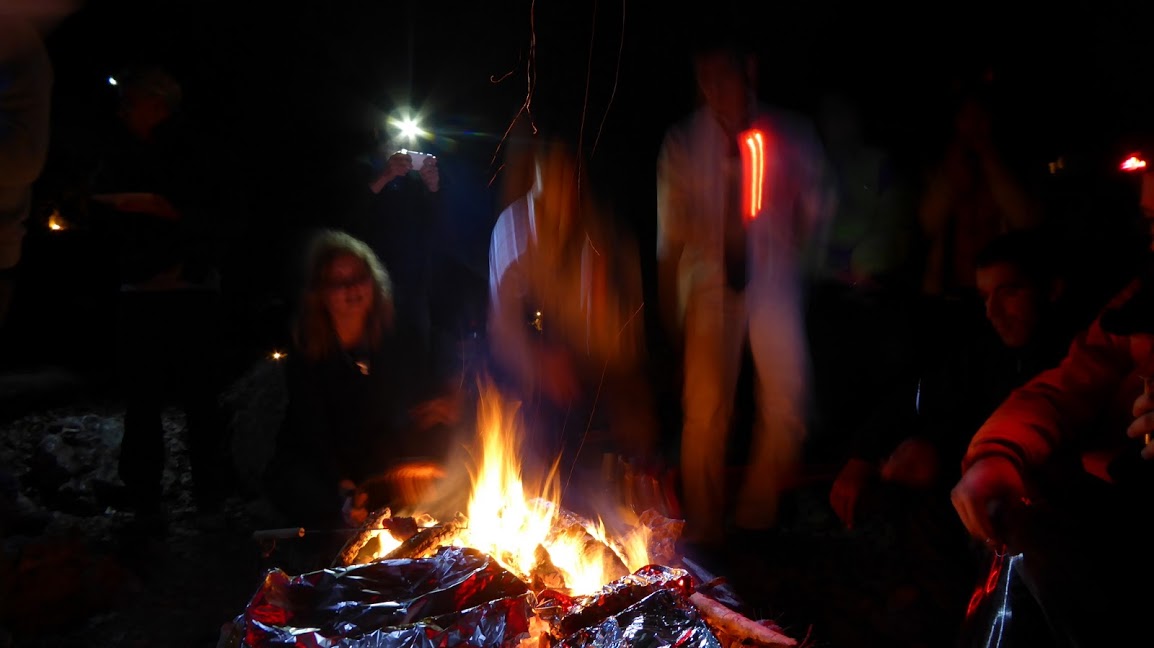
When the temperature drops and we find ourselves living beneath the clouds for weeks or even months going up to the mountains to get above them is always pleasant. Another option is to take advantage of the cool temperatures to explore caves where the conditions are constant year round. For Halloween a group of us went to have a bonfire and barbecue at the entrance to the Big cave of the Grottes des Fées. [caption id=“attachment_2665” align=“aligncenter” width=“660”]Improvised BBQ Improvised BBQ[/caption] We explored both caves. We explored the large cave as far as it was possible to do, had a snack and then we went to the second smaller cave. The video below shows the entrance to that cave. The video above is from when the snow melts. As the snow melts so much water is released at once that it floods the cave around once a year. The cave system has 21 kilometres worth of tunnels, passages and more. Animal remains were found within, mainly fossils and cave bears. The earliest records of  this cave system date to the 1700s with more exploration taking place in the 1800s with notable water flow in the 1950s and again in the 1990s. Over the last decade people have explored the cave system using wind as a way of seeing where new passages could be found. We see in many of the accounts written in french that an important aspect of cave exploration is finding the wind. It marks where big chambers are and where excavation of debris can take place to clear paths wide enough for people to cross through. The large cave is easy to explore as it is possible to spend most of the time and there are no or at least very few squeezes. The large cave terminates at a metal door where progressing further is not possible unless you are with a trained guide to introduce you to the really interesting parts of the cave. The small cave is more interesting to visit because it gets cramped and there are moments where you have to worm your way along. Either your arms are ahead of you or behind you. There is no way to move them once you cross through. In total there are two or three such passages. As it widens after these squeezes the motivation to explore remains intact. Tomorrow we will finish exploring the little cave and in future, maybe in summer we will find a guide to help us explore the rest of the cave system.