Uncategorized

Totem Escalade - Bouldering in Gland

The three common forms of climbing are Rock, climbing, via ferrata and bouldering. Rock climbing is an excellent and amusing sport that requires living in the right place, having the right equipment and knowing the right people. I enjoy the sport but have not found a group to go with. Via Ferrata as I love to call it is Rock climbing for tourists. The equipments and routes are set out and prepared so that those with the correct experience, head for heights and equipments can explore the landscape in an interesting and dynamic fashion. The last of these is bouldering. Bouldering is a form of climbing without ropes. In the wild it requires finding a bit of rock and studying the rock to find a route. On Sunday I noticed on Facebook that a new indoor climbing place was opening in Gland. Totem Escalade is an indoor bouldering place where you can practice climbing indoors. As autumn and winter approach this is welcome. It is based by the bowling in Gland, next to where a night club used to be. It has a central structure off which are four climbing surfaces with coloured paper to mark the grade of the climbs. As you progress you can attempt harder and harder routes. Bouldering is physically demanding and develops upper body strength. You need to use your arms, fingers and back muscles to hold on and make progress along the route you have chosen. As you try a number of routes a number of times so your strength will begin to fade. After two hours of enjoyment my hand muscles were done. I can still feel them as I write this blog post. I love that a climbing wall is so close to Nyon. For years I have been looking for this. Now that I know about this climbing wall I will be a frequent visitor. I want to improve my technique and I want to increase my strength so that for the next via ferrata season I will be that much more comfortable.
Via Ferrata du Diable - Aussois

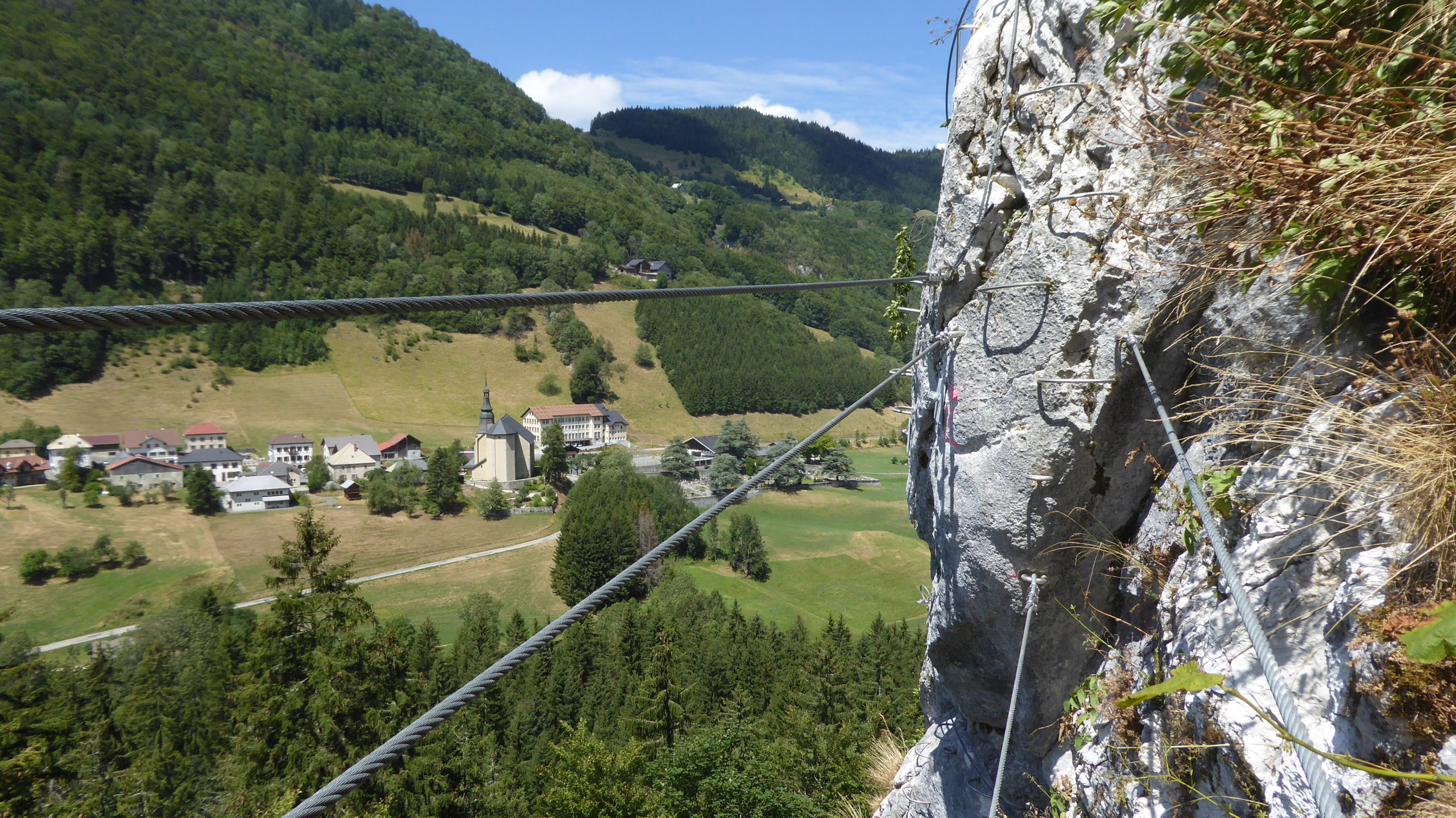
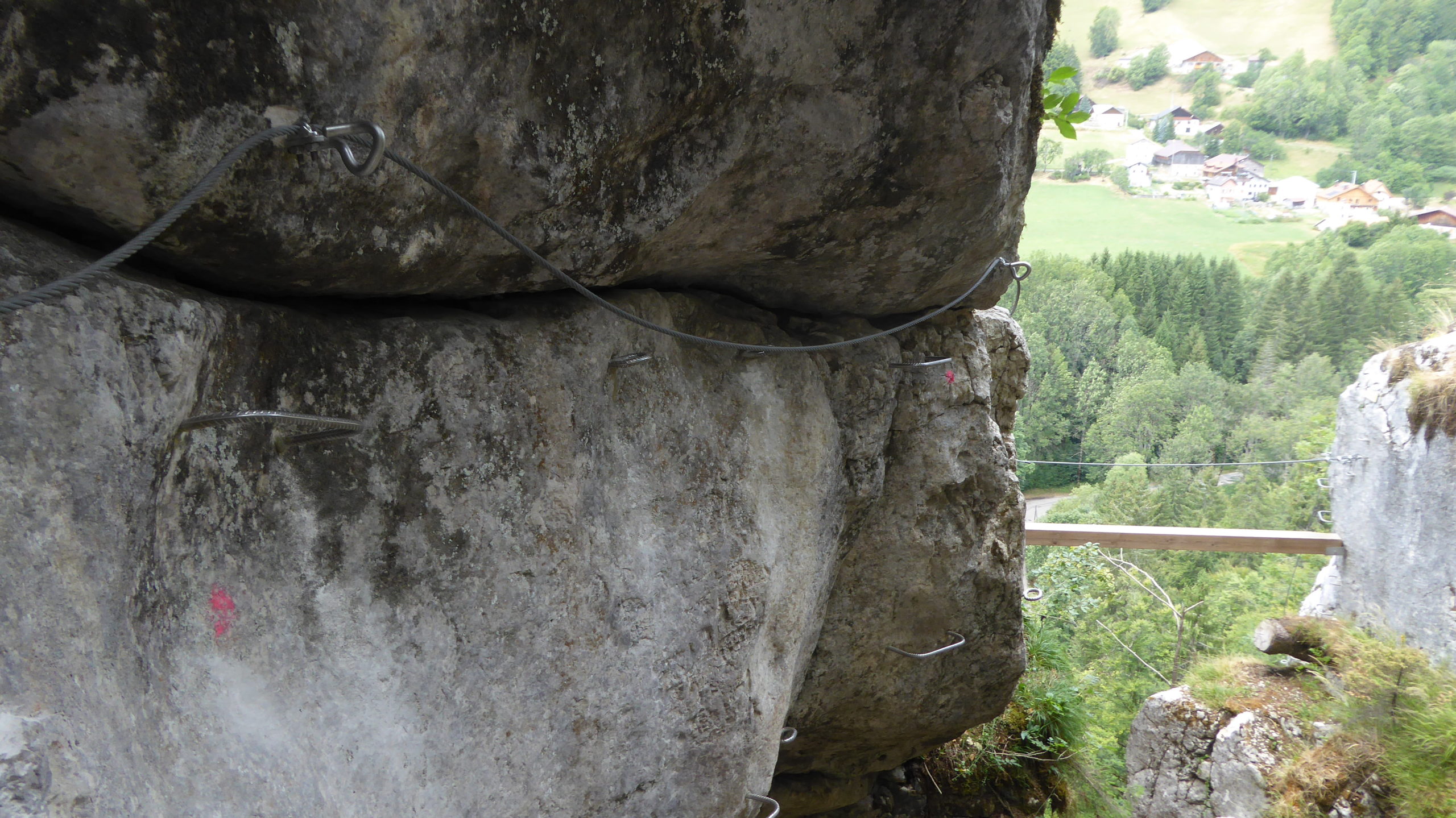
The Barrière de l’Esseillon are a line of fortifications two hundred years old and capable of holding two thousand soldiers in total.The fort Victor-Emmanuel is still standing and in it’s day could hold up to one thousand five hundred troops. This fort overlooks the via Ferrata. Some drone shots of the region in winter The Via Ferata du Diable is a series of via ferrata routes located around a bridge called Le Pont du Diable (Bridge of the Devil) which crosses the river L’arc (The Bow). This set of via ferrata varies from two easier ones that are suitable for children to four via ferrata that are suitable for various skill levels as long as you are not afraid of heights. The last one is going to challenge your courage and stamina because it is high off the ground and there are overhangs. The via ferrata are numbered so if you do them then do 6 followed by 3, then walk back and do four and five so that you complete a loop without back tracking. If you want to do the seventh then be ready to be high off the valley floor, to cross a monkey bridge, a nepalese bridge and a more conventional final bridge. There is an escape route but by this point you might as well finish the via ferrata and walk back. [gallery columns=“4” ids=“2573,2574,2575,2576,2577,2578,2579,2580,2581,2582,2583,2586,2587,2588,2589,2590,2591,2592,2593,2594,2595,2596,2597,2598,2599,2600”]

The Dumbing Down of mainstream media

Recently I have found mainstream anglo-saxon media much harder to tolerate. A few years ago I went to see 90 films in 9 months. I had no TV and the World Wide Web wasn’t quite as accessible then as it is today. For years I could watch BBC World from the moment I woke up to the moment I went to sleep. I also read articles and blog posts. I can’t stand the hollywood film output anymore. They are so comfortable with their formulas that within ten minutes I knew the plot line. I used to read dozens of newspapers a day and dozens of blog posts a day. I noticed that blog posts started to become formulaic and so stopped reading blog after blog. The quality of content went down at the same time as output went up. Every blog post was a Top Ten article. Newspaper headlines used to provide the audience with information about what the article was about. You’d read the headline, skim the first paragraph and decide what to read next. As Social media became socially acceptable for growing portions of society so we see the decline in headline usefulness. Headlines should answer the who, what where, when, why how questions and engage you as a reader. The Guardian, the BBC, The Independent and other news sources rather than writing headlines about the content of articles write sensationalist headlines that are designed to blackmail you in to clicking a link. Usually the articles hidden behind these headlines are a waste of time. They provide little of value and they assume ignorance of current affairs. We live in the information age. Within 15 seconds whether you’re sitting at the top of a via ferrata or in a library you can get information on any topic that interests you. Remember that the web is the hypertext markup language. When you write today you can add links to help contextualise the story, you can provide videos and pictures. You can also write in as much depth as you would like. In the information age I would have liked, and I would have expected that writing would become more demanding. Knowledge would be assumed and context would be easy to provide. When background information is a search engine result away it would be logical to assume that experts and writers could write as if we, the lay reader, were also experts. Look at the way the refugee crisis is covered. We see terms like “thousands drown in sea” “Fortress Europe should let in more refugees” and many more phrases. These phrases do nothing to inform and educate the audience. They are only entertaining us. They are encouraging prejudice and stereotypes rather than discourse. With unlimited bandwidth, time and space the topic of refugees and migrants could be covered in great depth. Documentaries could be produced to provide context as to why people are pushed from where they lived. Xenophobia is a result of over-simplification. Imagine that tomorrow when you wake up you see François Hollande or David Cameron in Calais speaking with refugees. What effect would that have on the national debates of migration? We see ourselves as liberals and we see ourselves as citizens of the world. Why, as citizens of the world do we never see our leaders visit refugees? Let’s forget the status quo and let’s go for a contextualised actuality. (Actuality, Actualité, french for news. I chose not to use the stigmatised word Reality). Another example of the dumbing down is the TWIT network. I used to love listening to those podcasts. I would listen to at least five or six of their programs a week. TWIT, Macbreak weekly and others. I started to lose interest when they switched to video and my interest decayed completely by the time it was more chit chat than news. Editing gave their shows value. Without editing you’re wasting an hour and a half of listening time. Media production and advertising revenue is based on the “Lowest Common Denominator” theory. The simpler content is to understand the more views it will get. The more views it gets the more valuable it is. When media assets are owned by the financial sector and when giving dividends to share holders is more important than value to costumers so you get the erosion of quality. This erosion in quality means chasing a greater number of eyeballs with an ever decreasing quality of content. The Guardian, the BBC and other “mainstream media” companies have fallen in to the trap. They don’t need the money, they’re subsidised, but they need the eyeballs to justify their funding nonetheless. If the mainstream media want to destroy themselves then that’s fine. In theory. In practice this leaches in to the social media landscape. As an early adopter I join social networks and social media distribution platforms in their early days, when the intellectual, entrepreneurial and curious people are around. Conversations and friendships make empty social networks look and feel lively. As users engage stickiness grows. As stickiness increases so value increases. Look at Twitter and Facebook as prime examples. Twitter was a fantastic conversation tool in it’s early days, so fantastic that for the first time in a social network I would meet with users every week at it’s peak. Facebook was a uni friend network. We had all partied together and as we knew each other well we could be open and social in a closed network. When advertisers, social media gremlins and PR professionals came in to these landscapes so the conversation chased the rabbit down the hole of the lowest common denominator. Conversations diluted and friendships decayed to the point where trolling became standard. The dumbing down of the mainstream media led to the decline in sociability and friendliness on social networks at a time when social media became mainstream. As a positive last thought everything is cyclical. We will see mainstream media smarten up again. We will go back to long form articles, and we will go back to interesting film plots.

The Bellevaux Via Ferratas

This year I went to the Bellevaux Via Ferratas in June and the area had been damaged by the intense storms and rain from weeks of rain. I went there on Tuesday and the via Ferrata des Cascades was different. For a start there was no water in the cascade. As a result those who were canyoning down the waterfall were dry. It was also much quieter and the sensation from the via ferrata was different. [caption id=“attachment_2460” align=“aligncenter” width=“660”]The section with the slight overhang. The section with the slight overhang.[/caption] Water is dynamic, constantly moving and making noise. As a result it provides a sense of motion and danger. When water is not flowing footholds are easy to find and your focus can remain on the via ferrata. The Cascade is my favourite beginner via ferrata. The conditions I think beginners will appreciate are: 1. Easy access. Within 200m you are at the via ferrata ready to climb and 2. Proximity to the ground. This via ferrata does climb quite a bit but you are never that far off the ground so vertigo will not add badly to how exhausted you are by the end of the path. This via ferrata has two thick beams you cross over the river and one nepalese bridge (one cable for feet, one cable per hand, fourth cable for the carabiners. There are short bits where you are climbing vertically and then one section where you negotiate a slight overhang. After this you have two more beams and the VF is finished. [caption id=“attachment_2465” align=“aligncenter” width=“660”]The Village of Bellevaux an hour’s drive from Geneva. The Village of Bellevaux an hour’s drive from Geneva.[/caption] If you have energy left over you have two more via ferratas to enjoy. These are the Via Ferrata du Chatelard and the Via Ferrata “La Grotte De Cristal”. These are harder via ferratas. In the case of Chatelard the estimated completion time is about one hour and fourty five minutes. I completed it in over fourty minutes so I am not a reference. This via ferrata starts by ascending diagonally for a bit before continuing horizontally a bit further. Hand holds are not always easy to access and there are certain portions where you have an excuse to dyno (propulse yourself) to grab the next hand hold. The Chatelard is physical but the views of the valley are nice. As you can see from the picture above you have a nice view of the town to the right if you have your back to the cliff and a nice view of the valley if you look to the left. [caption id=“attachment_2471” align=“aligncenter” width=“660”]View from the Nepalese bridge View from the Nepalese bridge[/caption] The Nepalese bridge offers a nice opportunity to admire the landscape. After this point you soon reach the combination point where the medium and hard via ferrata combine. From here you continue towards an excellent tyrollean. I tried it with both the red and the silver devices. With the red device I went fast and only had to pull for the last metre or two. With the silver one which I tried twice the ride is very fast. You hit the wooden ramp running. With a friend we did this twice each. I strongly recommend that you try the tyrollean if you’re with a group of people that have the required equipment. It’s a highlight of the day. When I do the third and hardest part again I will write about it. I tried it one or two months ago and did find it fun. I may write about it this weekend.

La Cascade Via Ferrata in Les Diablerets

This year I finally got to see the Via Ferrata of the Waterfall (La Cascade Via ferrata) in Les Diablerets Switzerland. As a child it is a place where we would walk as children and experience the freezing river water. A few days ago I went for the via ferrata. It was amusing to be with friends rather than family. As I know this landscape so well the effort felt minimal. The Via ferrata is a nice medium via ferrata. I’m tempted to say that I found it easy but that’s going to mislead people and I don’t want them to get stuck. According to the geotrails post this is a demanding VF because of the overhanging bits. That’s where doing one or two VF a week pays off. If I was to do this via ferrata alone I would park at the Montée mecanique of Isenau, take the egg up to the top and then walk down by the lake and towards the Glacier 3000 lift. From there I would cross over to the via ferrata on the other side. Access to the via ferrata is quick and the path is easy. The Via Ferrata has some vertical moments but most of the time you are moving laterally. You have a very nice view of the valley below. 1050206After you have completed the principal part of the via ferrata you come to a clearing where rock climbers have a number of routes. I recommend keeping yourself attached to the via ferrata cable. Two people slipped on the soil and it’s a useful habit always to stay attached when the option is available. From the flat section you climb a little and then head back down through a split between two rocks. From this point you can head down and consider the via ferrata complete or you can have fun and try the tyrollean. The tyrollean will require you to walk along some slippy rocks to where the platform is. Here you can attach yourself and enjoy the first tyrollean across to the other side. It’s not the fastest tyrollean I have done but it’s the first time I pass under a waterfall and that is fun. When you get to this side you detach, walk down for a short distance and can cross over again. The second tyrollean is slow and there is a good chance that you will have to pull yourself across as I did. At this point you can follow the path down towards Les Diablerets along the river and back to where the car is parked.

Exploring Geneva at 30 kilometres per hour

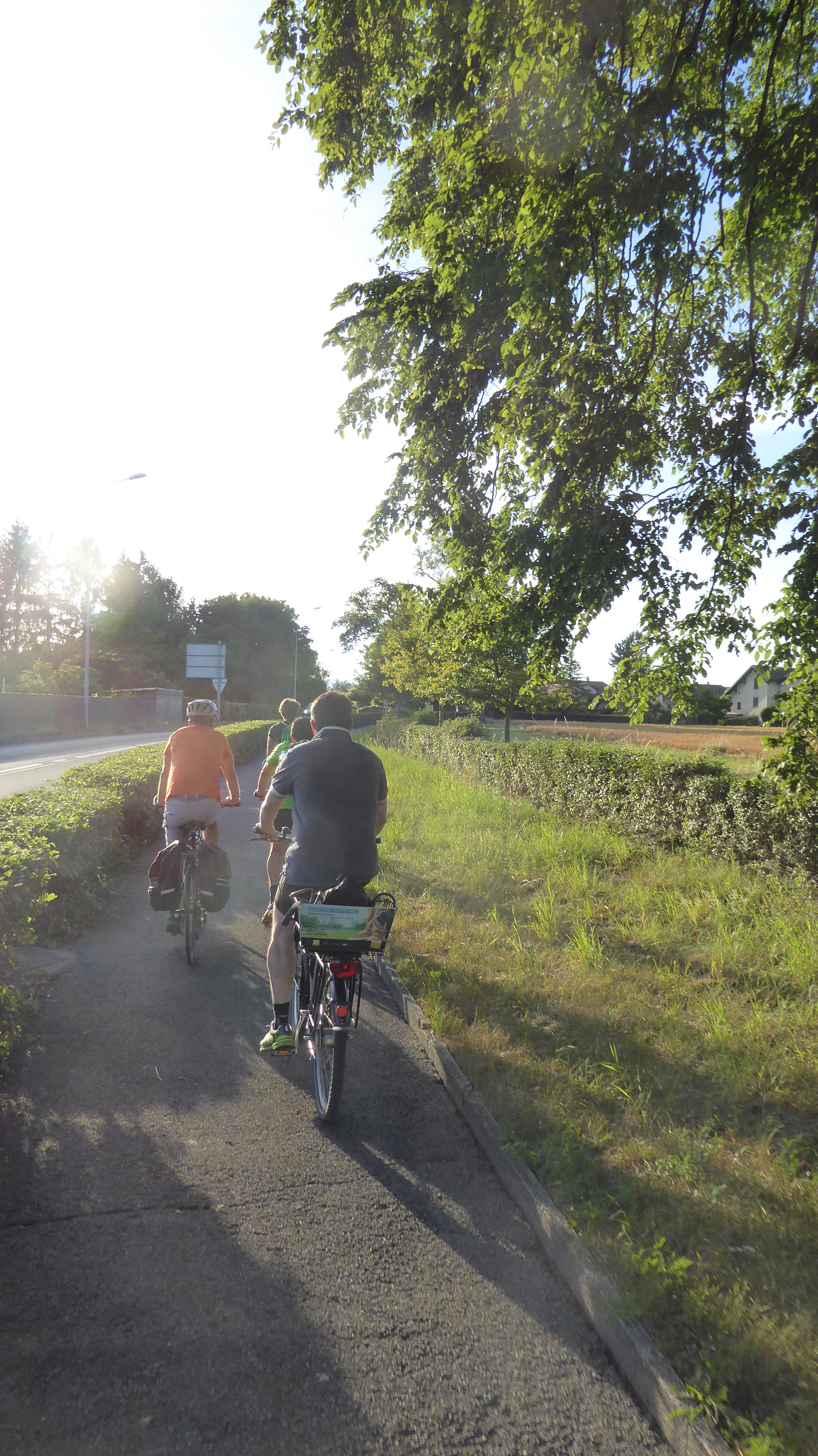
Exploring Geneva at 30 kilometres per hour makes a nice change from driving in the city. Yesterday I met with the Geneva Bike and beer group. It’s an activity from within the broader Geneva based Glocals activities. [caption id=“attachment_2408” align=“alignleft” width=“169”]Exploring the Geneva landscape by bike Exploring the Geneva landscape by bike[/caption] The pace is reasonable and the loop is about 20km for this second group ride. There are a lot of opportunities to cycle away from traffic and on quiet roads. It was fun for me to see the landscape differently. For over a year I used to drive in that landscape to get to dive sites and back. This time I was far lighter. As with everything in Geneva the group is international with people from a number of countries and continents. I will participate again.

Cycling up to La Barillette

Cycling over short distances can be a challenge especially when that short distance takes you from the foot of the Jura to the top over 12 kilometres at a 6-10% grade. Cycling up to La Barillette is an endurance test. Perseverance is key. [gallery ids=“2394,2395,2396,2397,2398,2399,2401”] You can start the climb either from Cheserex or Gingins. The climb starts sharply and takes you up in to the forest. As you climb you follow the winding road by a stone block where old road rules are written. The stone dates from the 19th century and speaks of the regulations which were in effect. The path takes you up some one way and two way roads. At every kilometre as you climb some plaques tell you the gradient for the next kilometre as well as the gradient. As you progress these are welcome. They let you know how much further you have to go. I have attempted this climb four times in the preceding months and made it up twice. One of the aspects to be enjoyed with this route is the lack of cars. If you went up via the Route de St Cergue you would encounter cars every few seconds. On this route cars seldom pass and when they do they are sometimes curteous enough to slow down and give you space as you overtake. You can also enjoy some great views of the Mt Blanc and the Lac Léman. As you go up so the view gets better and better. It also gets cooler. The first 9 kilometres are the hardest. For 9 kilometres you will be struggling to keep your forward momentum and there is a chance that on the first two or three attempts you will give up, especially if you use as heavy a bike as I use. Once you have reached the 9 kilometre mark the path flattens out at around 1000 metres and it is just a matter of cycling for a further 3.7km. When you get to the top you have a beautiful vista of the Lac Leman. You can see from Villeneuve all the way to Geneva. You can see the Alps in their full glory and you can see the Canton de Vaud. You can see Lausanne, Morges, Nyon, Cheserex and many of the villages below. It’s a great opportunity to spot peaks and get to know them. There is a map showing you the name of the peak and it’s shape. If you train over the coming month and see that you have a good time on Strava then you could join the VTT race and see how you compare with others. In summer months from Wednesday to Sunday the restaurant de la Barillette is open. It has a great view of the landscape which you can enjoy while eating an entrecôte or fondue.

FLYER THE ESSENCE OF E MOUNTAIN BIKING

  Mountain biking is a sport that is growing in popularity. We see that technology is keeping up with the riders. Between suspension, specialist tires and safety equipment the sport has had the freedom to become more adventurous. Bigger jumps, more travel, stronger components all allow the sport to become more extreme. Usually there are three ways to get to the top of a mountain. The first option is to ride up but with a mountain bike that can be tiring. I have an area where I can mountain bike near home but it’s a 12.7km ride up with a 10 percent grade. It takes two hours to get to the base. I could of course take the car up and cycle around at the top but this requires removing the front wheel and putting the seats down. Another option is to head to specialist resorts where the remontée mécanique are equipped to take bikes to the top of the slope. The third option is to walk up and push the bike. In this video we see a fourth option. An electric mountain bike. I like the idea of mountain biking this way. I like the notion that the mountain bike will assist with getting up the hill more efficiently. Several times I have cycled up a 10% gradiant for a distance of 12.7 kilometres. With the mountain bike I use it takes 2 hours of almost non stop pedalling. It leaves me with little energy to enjoy going off road at the top. With a flyer I’d let the bike get me to the fun part and then use my own power to play up there. I won’t buy one of these bikes but the video is interesting to watch.

Tudor Monastery Farm - A documentary series

I took advantage of a rainy day to watch a series of documentaries by the BBC called Tudor Monastery Farm. It is a documentary series where three individuals live the life people would have lived at the relevant time period for a year. During this year they try farming, mining, fishing and other skills and crafts from the time. These are observational and experimental documentaries. They take the observational cinéma verité and Direct cinema approach to factual television production. As you watch these documentaries so you are transported to a different time period. For years or even decades I thought of this time period as a bad time period. I thought of the church as being an oppressive force. Through this set of documentaries I eventually felt sad that monasteries and the way of life that was illustrated in the series of documentaries was dissolved by Henry the Eighth. Imagine a monastery with 20,000 sheep, imagine the work that was lost by stone masons as the need for monastery construction and other activities declined. If you find this documentary series I strongly recommend watching it.

Mountain biking down a via ferrata

VIA FERRATA from Summitride on Vimeo. Of course riding a mountain bike down a via ferrata is impossible. What is possible is riding the bike at the start and end of a via ferrata. In this video we see an individual ride down some routes where we would not feel at ease with full safety gear.