Archives

A chevreuil in 4K

Yesterday I went for a walk around the foot of the Jura and there is an enclosure where deer are kept waiting to be slaughtered for meat. As the Chasse season is coming up this park might not be as busy. This video was shot using the Sony Xperia Z3 compact. The image is a little blue for my liking. I look forward to testing the Xperia Z5 compact with it’s improved sensor and new image stabilisation technology. I have no 4K monitors on which to assess image quality at the moment.

Sony and Crosscall Mobile phone advertising

The Sony Xperia Z5 compact is for women who blog about fashion and the Sony Xperia M5 is for baristas who dream of owning a sports car but can’t quite pay for it yet. These adverts will never hook me in to wanting their products. I’m the type of person who lives in the countryside and spends his weekends in the mountains on adventures. I want the Sony Xperia Z5 because of it’s fast autofocus, it’s new technology and it’s 4k recording technology and new image sensor. The geek press gave me information about the device and that’s what woke up my interest. Marketing to geeks is all about the specs and the technology. Marketing to normal people is about “This is the lifestyle you have and this device will survive it”. In the land of Sony people live in cities. Now to contrast with crosscall.   Crosscall make rugged strong mobile phones and their advertising is more in line with my own lifestyle.In the space of one month I shattered three screens on two phones. Two of those screen shatters were as a result of playing Ingress. In one case I stood up and the phone slipped from my lap on to the floor, bounced and then fell down again. It fell about two metres and the screen became unresponsive. In the second case I tripped on a step and fell with my hand rotated so that the screen took the impact rather than my wrist. I was so disgusted with myself for the incident that I was tempted by the Crosscall Odyssey+. The phone is rugged and would probably survive such a fall. It has excellent battery life but it’s data connection leaves to be desired especially when playing location based games like Ingress. Crosscall advertise their devices as rugged, for the adventurous among us. They use runners, surfers, climbers and snowboarders as brand ambassadors. It’s through one of Xavier De La Rue’s posts on Facebook that I learned of the brand and that my curiousity was peaked. The Crosscall Odyssey+ is a niche device. The Trekker X1 has a better chance of appealing to a broader audience.   I love that devices by Sony and Crosscall are being advertised as weatherproof now. As an iphone user I liked that Lifeproof provided me with weatherproofing. I appreciate that brands are making their devices weatherproof by default. Soon it will be possible to throw people in to pools without warning once again… once autumn and winter have left place for next summer, of course.

Switzerland, Fitness centres and the mountains

For three years I was a fitness club member. I loved going to the gym up to three times a week when possible. I loved training so much that I bought apps and devices to track my progress. Any time that I could not spend three sessions a week at the gym I felt disappointed. That passion, when you are in full time work can be hard to keep active. I tried going to the gym at 6am and I tried going after work but the habit never picked up. In Switzerland fitness memberships can vary from 700-900 CHF per year to over 1200 CHF per year depending on the membership perks you take. If you go to the gym 52 times a year that’s 23 CHF per session. If you go twice a week it’s reduced to just 11 CHF per week. If you go three times a week it’s 7 CHF per session. In theory this is a reasonable price. It’s less than a week’s pay for most professionals. In practice you want to justify the expense. You want to go to the gym when you have time. This means weekends, evenings and on public holidays. I was often frustrated to have free time but for the gym to be closed. I would love to see gyms that take your outdoor sporting passions in to account. Running and cycling are already somewhat covered in the lac Léman region of Switzerland. What I would like to see next are ski days, via ferrata excursions and canyoning within the club. During week days and when the weather is bad you would train in the fitness centre. As soon as summer weekends and holidays would allow then as a fitness centre you would enjoy the great outdoors. I see through Glocals and facebook groups that the interest to do activities in groups is there. Fitness centres could attract a younger demographic to join. I love physical fitness and I love exercise. If I lived in a city like London or Paris I’d be happy to sit in a gym and train. I’d have filtered air and less traffic to contend with. As I live in the Swiss countryside though I want to take full advantage of what nature has to offer. When I find a fitness club that offers discounted canyoning, waterskiing and other activities, and subsidised via ferrata and ski days then I will rejoin.

Vanity fair is wrong to label Zuck as the top disruptor

Zuckerberg Tops Vanity Fair’s 2015 List of Disruptors Every successful social network first establishes a friendship network where a tight knit group of people interact with each other on a very frequent basis. In the case of facebook it was uni friends interacting with uni friends from the same campus. On twitter it was people in the same time zone conversing with people in the same city as themselves. It eventually led to face to face meetings and a new network of recognised friends. The same can be said of Seesmic when it was about “Join the Video conversation”. Notice my avatar… It’s the seesmic racoon. :-) Zuck wasn’t a disruptor or genius so much as the right person in the right place at the right time. Nothing he did was innovative. He just packaged it effectively. As a side note I have noticed that over a number of years the social aspect of twitter has suffered. It no longer feels like a social social network. it feels more like Google Reader. it’s amusing to see how social networks evolve and revolve from one type of network to another depending on what people want- Mark Zuckerberg Tops the 2015 New Establishment List—and Snags the October Cover! I remember when there were dozens of RSS aggregators for the sharing and distribution of blog articles. Over time traditional sources used the same technology. Google Reader and Google News became good sources for getting news stories and information. Facebook and twitter, social networks, decided that conversations were a waste of time and so encouraged their networks to be used as news aggregators. Recently Facebook reached the billion user daily mark. Amusingly this happened when the social network is at it’s weakest. It’s Unique Selling Point, connecting friends, has been lost. I went back to blogging because I grew tired of the rubbish being shared on twitter, facebook and other social networks. For years I insisted that social networks were a great way of meeting new friends and finding new business opportunities but as everyone overdid it with followers so the conversation and personal connections decreased. In the article they state that “Facebook chairman and C.E.O.Mark Zuckerberg has struck deals with _The New York Times_and BuzzFeed to publish articles directly into users’ pages.” I don’t go to facebook for news. I use the NYtimes app, I use Google News, I use news360, scoopinion and other applications. I use the applications because I found the condescending and sensationalist tone used by facebook marketers was offensive. We are a generation of university graduates on a university social network being treated as if we were primary school students. I don’t appreciate it. I also don’t appreciate the multiple posting of the same articles and tweets in timelines both on twitter and facebook. In theory twitter is an app that you keep open and monitor throughout the day. If something has to be posted several times then congrats on having such a disengaged audience. ;-).

Fear and Strength in Via Ferrata

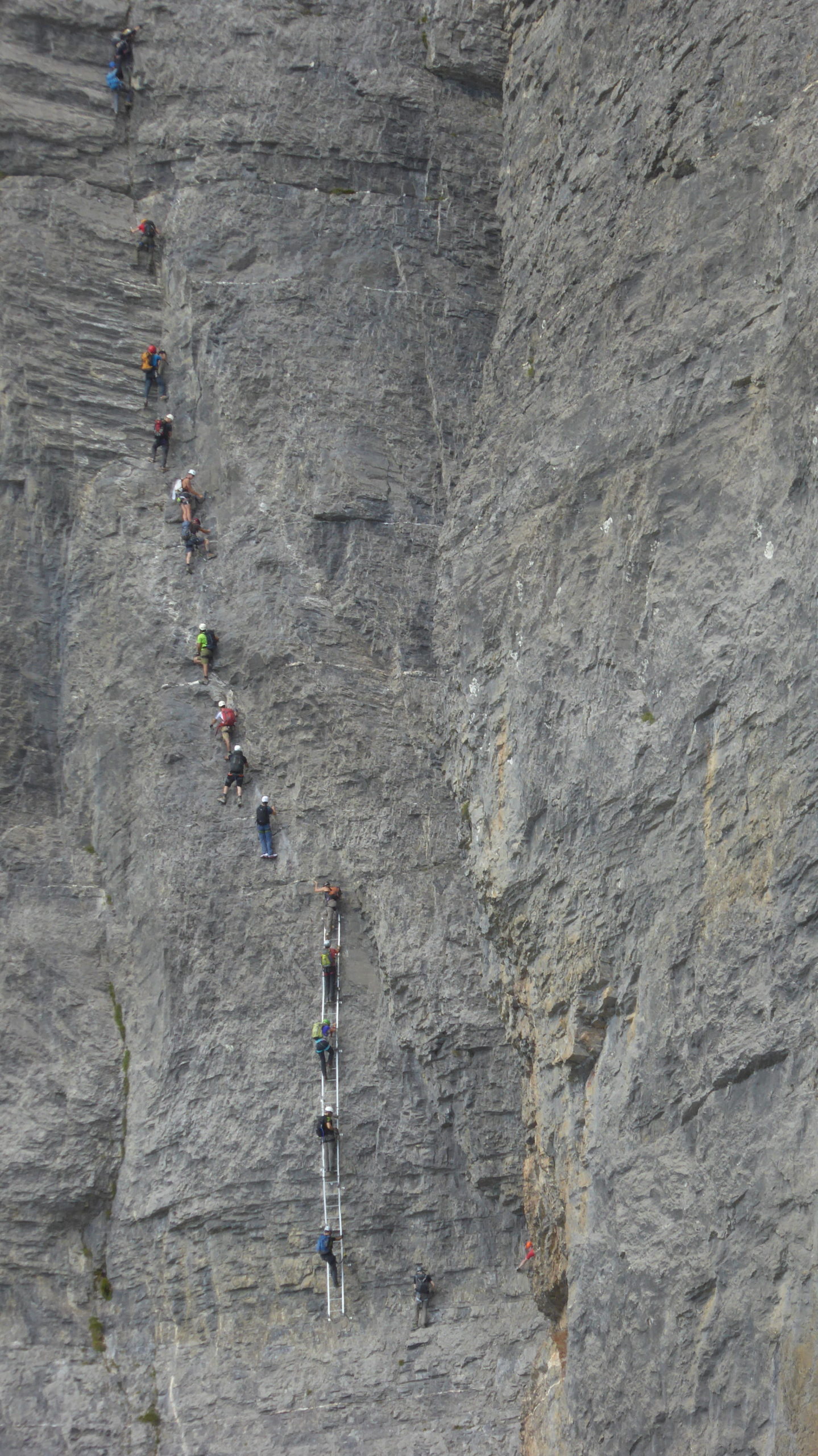
Fear and Strength in Via Ferrata play an important role. Fear drains us of energy. In Rock climbing this is fine. If you run out of energy you abseil down and you call it a day. In Via Ferrata when you run out of energy you are stuck on a rock face and people usually do not have the required safety equipment to help you out of the situation. It is for this reason that we read so frequently about rescues on via ferratas. I read that at fort l’écluse there have been four rescues this year, at Saillon there have been a few and in Bellevaux there may have been as many as ten. The point of via ferratas is that anyone can practice them. In theory once you get the harness, the y-combinator and helmet you are ready to climb. In practice you need to take several things in to account. Via Ferrata are graded according to three factors. These are Equipment, Height off the ground and physicality. Some via ferrata are well equipped and some leave you to improvise hand holds and foot holds on the cliff face. You also need to trust your own equipment. This does take some time. Height makes us afraid and our fear tenses the body. When the body is tense it uses a lot of energy. You stay closer to the rock and you use your arms to raise yourself whilst staying as close to the rock as possible. Through practice I have seen my confidence grow and in the process my technique has evolved and adapted. I often keep my arms straight and pivot about my hand as I push upwards with my legs. In so doing I climb fast and without burning energy. I can save energy because my fear has faded over the years. Whilst a beginner will try to keep their centre of gravity as close as possible to the rock I do the opposite. I swing out and up with every step. It means that I save energy for the overhangs. Two days ago someone who was afraid, who had far less experience was using his arms rather than his legs. Arms have tiny muscles compared to legs so they tire much sooner. In rock climbing if you make mistake you can usually be lowered back to the ground and within a minute or two the incident is over. In Via ferrata you do not have this luxury. In Via Ferrata when you start to get tired you need to continue. If you can’t continue then there are three options. The first is to call in a helicopter to take you off the cliff, the second is for a mountain response team to come and assist you and the third option is self rescue. For the latter I mean a group rescue. In the first two cases these are trained professionals who will resolve the incident relatively quickly. Always climb with people more experienced than you as they can help you. In one rescue scenario a person ran out of strength and let go just metres from the end. In this case knots were put in a rope so that the person could climb the rope as if it was a ladder. In another case a rope was used as a counter-weight where the distressed climber had to climb and two of us were supporting the weight as we were given slack. This is not ideal as it requires a lot of strength if the person being helped is exhausted. In the third case a rope and pulley system was used. In this case the force exerted was tripled and the rope was longer. It took just one person for this rescue. When we saw with what ease someone could be rescued we decided we needed the same equipment and to get proper training. Via Ferrata is a fun and exciting sport that brings you to beautiful landscapes and it is easy to assume that you can make it from point A to point B. People should take the time to assess their level of strength and stamina before starting. They should also rest when they have the opportunity. The problem with fear is that it is a positive feedback loop. The more afraid you are and the more your muscles tense, the tenser you are the more tired you are and the more afraid you are. Knowing when to take a mental and physical break in via ferrata is essential. Take breaks to drink and eat something before you get tired. Clear your mind and relax before you continue. It is better to take twice the recommended time than to run out of energy half way through a Via Ferrata.

The Psychology of Via Ferrata.

  The psychology of Via Ferrata is similar to the psychology of climbing except that everyone is moving constantly and there are few pre-requisites. As a result of this it is easy for people to push themselves beyond their comfort zones. They can be made uncomfortable by how high they are off the ground, how little they trust their equipment or the equipment on the cliff face. Peer pressure can also help make the challenge harder to cope with.

The Tichodrome Via Ferrata behind Neuchatel is not for beginners

The Tichodrome Via Ferrata near the Creux du Van is not a via Ferrata for beginners. Yesterday I went with a group of people and it took two and a half hours rather than the one and a half hours that it was meant to take. There are two principal reasons for which this is not a via ferrata for beginners. The first reason is that it is high off the ground. Not only are you high off the ground but you start near the cliff. Confirmed Via Ferrataists and rock climbers will see this height and it won’t worry them but novices who are not acclimatised to such heights will be getting to grips of being so high. Imagine trusting yourself and your equipment so high off the ground. The second flaw is that it is poorly equipped. There are very few hand holds and foot holds on this via ferrata. Most of the time your feet are on bare rock where feet can slip and where there is barely enough for more than your toes or a side of your shoe. As a result there are chances that a foot slides every now and again. The third challenge is the cable. It is lose so when you put weight on it it swings out. Imagine as a beginner trusting the cable to hold you whilst standing a fair distance off of the ground. This is a terrifying via ferrata for less experienced praticitioners and I strongly advise you not to go until your less experienced friends have done a few more via ferrata. The fear factor for this via ferrata is an excellent warm up for Leukerbad. That’s a demonstration of how unadapted I think this via ferrata is for beginners.

Social Media and Via Ferrata

People on linkedin were discussing whether social media campaigns are worth organising and keeping. When it comes to extreme sports such as Via Ferrata, rock climbing and other extreme sports then I believe that the audience is ready and enthusiastic enough for a social media presence to be desirable. Via Ferrata is an outdoor sport that can be practiced in France, Italy, Spain, Switezrland, Austria, Germany, the United Kingdom, the United States, Canada and Peru. As a result of the diverse place where this sport can be carried out so social media became an excellent avenue through which to share information about the sport.   I have loved the sport of via ferrata for five years now, half a decade. What I loved about it was the simplicity of the sport. After just two or three climbing lessons and going with a guide once I saw that I could handle via ferrata comfortably without a guide. I always insisted that I would take people with rock climbing experience, not absolute beginners. Via Ferrata is a specific sport requiring specific equipment and specific experience. It requires a head for heights and an ability to hike for an hour or two before a climb and another hour or two after the climb. As the locations are usually remote it also requires someone with a car and whom can navigate. Social networks such as Glocals for Geneva and Lausanne, Xdreams, for Geneva specifically and the Via Ferrata Suisse group for the French speaking part of Switzerland are good places to find participants. The first two examples are to connect with the international/english speaking community and the latter is to connect with the French speaking community. Glocals is a local social network helping the international community in Geneva, Lausanne and other cities to meet up and be active. Through this site you can meet people to work on hangover, meet people to scuba dive and meet people to do outdoor sports such as hiking, climbing, via ferrata, swimming, canyoning and much more. Due to the nature of the social network are spread around Switzerland and the meeting point is usually the event, with car sharing from strategic points.   Via Ferrata Suisse is a nice online community for French speaking via ferrata practitioners on Facebook. As they are spread across the French speaking parts of Switzerland they can provide information and tips on via ferrata that are local. Aside from connecting people social networks and social media are great for the sharing of pictures, personal accounts and textual information about via ferrata. Some people want beautiful landscapes and so pictures will help them select which via ferrata to do. Others are afraid of heights so they will avoid being too far from the ground. A third group will look at how exertional via ferratas will be. I have seen two people run out of energy at Plan Praz and I have seen everyone feel weak by the time they finish the Leukerbad Via Ferrata. Tourism professionals and equipment manufacturers can benefit from a social media presence. I see that Iloveclimbing, Suunto, PETZL, Mammut and other brands actively share the adventures that either their athletes or enthusiasts of their equipment are enjoying. It’s a great way to make me dream of going to some locations, getting that piece of kit or trying an activity at that time of day. To give a specific example I have wanted to do the Moléson by night Via Ferrata for years now and have never got around to it. For two or three years it was because of work and this year it was because of the weather and because I had already booked Leukerbad for the weekend it was moved to. Next year I will make it. I love suunto, Mammut and PETZL. Rather than advertise to the city dweller like Apple, Fitbit and withings do they organise social media campaigns around the great outdoors and around extreme sports. As a result of their social media policy I identify very strongly with their products. In the case of suunto I have dive computers and fitness watches. I understand the passion that their athletes represent in their social media campaigns. Social media is about socialisation and passion. Via Ferrata is a sport that people feel passionate about but because it requires physical fitness and a head for heights your pre-existing group of friends may not be the best suited for your passion to take off. That’s where social networks and social media can help find new via ferrata, see what to be wary of and meet new people. According to these three parameters Via Ferrata and social media are perfect for each other. Sports companies, tourism offices and transport infrastructure would result from a social media presence.
Netflix provides a better opportunity for documentary content distribution than Discovery

In the 1990s when satellite distribution of television content was in it’s infancy we got a satellite dish and I would watch the Discovery Channel from the start of the broadcast day to when the programmes were played for the second time that day. By watching so many documentaries I learned a lot about the world. I watched Mythbusters, Lonely Planet, Modern Marvels and many many other documentaries. It is only ten years later that I stopped watching Discovery. By that time I was no longer in the family home and so documentary viewing was more restrictive. Whilst at the University of Bournemouth and the University of Westminster I did take advantage to watch as many documentaries as I could find. The dissertation I wrote during my third year of studies was about the documentary genre. I had an academic reason to watch these documentaries. It was no longer a hobby. Aside from the selection of Discovery channels and University VHS tapes documentaries can also be found on national and European channels. I am thinking of Temps Present, Passe Moi Les Jumelles and other factual programmes and current affairs content. These documentaries fit within a specific format to be broadcast at the same times every week. We then have artistic documentaries like those broadcast on Arte, shown at independent cinemas, festivals and more. These documentaries are not adapted for mainstream viewing. They fill a niche. They are sometimes hard to watch and other times so niche that aside from those with that passion or interest no one will ever watch them. The Discovery Channel network broadcasts set documentaries at set times on set channels for a set number of hours per day. Viewers can either watch documentaries as they are broadcast or on demand. As PVR arrived viewers could shape their viewing habits around their lifestyle rather than the other way around. Discovery channel documentaries have two serious flaws, that as a documentary professional cannot stand. The first of these is commercial breaks. When I watch content I want to watch it from start to finish. I don’t want it to be interrupted because it means that for two or three minutes I have to find something else to do. This could be a serious trigger to people having a laptop or tablet with them when watching TV. The second very big flaw with Discovery TV documentaries is sensationalism and repetition. I found that when watching hour long documentaries on Discovery television channels more than half of the time is spent repeating what has happened and what will happen with very little content left over. You will spend an hour watching a show that could have been over in just 24 minutes. This is an excellent way to lose viewers. Netflix is a video on demand platform. This platform makes available all of the content it has licensed to it’s customers. This content is ready to play within seconds and has no adverts. This is great for content creators. It means that they can spend more time moving the story forward. There is no need to worry about viewers starting to watch a show half way through. It means that if you have a 42 minute slot you can spend 52 minutes telling the story. This is great for content creators. The flaw of Discovery Channel documentaries and commercial television in general is that they make mediocre content and then add adverts every few minutes. This means that a mediocre programme will be watched from one commercial to another before the channel is changed. They live under the misconception that sensationalism and excited narration will keep viewers. It has the opposite effect, at least on me. Netflix allows you to watch the BBC Blue Planet and Planet Earth documentaries with no adverts. This gives documentary makers an advantage. Imagine watching Planet Earth documentary episodes that are 52 minutes long with an extra 15 minutes or more of adverts thrown in. For this reason Netflix is an excellent documentary distribution platform.

The Leukerbad Via Ferrata

The Leukerbad Via Ferrata is a mythical Via Ferrata for those who practice the sport in the french speaking part of Switzerland. It is mythical both for the duration and for the vertical movement. The climb itself takes around 5hr30-6hr and the vertical change is 1000m. Via ferrata is rock climbing for tourists. A team of specialists look at a climbing route and then install a safety cable, spikes and other features to help people climb the via ferrata. The cable is static. Via ferrata have a number of origins. Some via ferrata routes are along old smuggling routes, others were used by the French resistance as hide aways and others were used to get troops from one side of the mountain to the other during the first world war. In the 1960s to 1970s they were reinstated to attract tourists. Leukerbad is a spa town with a collection of baths heated by geothermal activity. This year I chose to stay at the Alfa hotel and the price included access to a covered parking, access to the spa and access to the lifts. When you see that the lift is 34CHF and the Spa is around the same price the saving is interesting. As the town is small I parked the car when I arrived and did not use it until I left. People like to catch the first cable car up and try to make it down before the last cable car down. Walking down to town is possible but most people are knackered after the via ferrata. The Via Ferrata has three main parts. The first part takes you from the base of the Via Ferrata, by the big Swiss flag and up to a terrasse where grass grows and people have snacks. If you are not used to spikes then this route will surprise you as much as it did me. I would recommend finding a shorter Via Ferrata (VF) with spikes before doing Leukerbad. [caption id=“attachment_2498” align=“aligncenter” width=“576”]Usually the Via Ferrata is not this busy. Two or three groups were active this weekend. Usually the Via Ferrata is not this busy. Two or three groups were active this weekend.[/caption] The second part can be tackled one of two ways. The first way is to climb up as a climber, using foot holds and hand holds wherever you can find them. For those with less experience pulling yourself up with the cable is possible. If you use the cable then do not make the mistake I made my previous three times. If you are not afraid of heights then pull on the cable perpendicular to the cliff. It’s easier. This requires that you are not bothered with heights. The route has been changed. It used to be a more direct and upwards path. Now the path zigzags until you get to the cave. Half way up the path to the cave a new VF variant is being added which takes you to the right and upwards towards a nepalese bridge before rejoining with the main route. The cave is interesting. It gets darker but you do not need a torch. In the cave you have two variants, easy, and hard. The easy route is along spikes and you climb up a ladder. The hard route has standard hand holds, a wooden bridge and then crosses over to the main route. Where the two paths intersect you exit the cave and go up a chimney. The Chimney is relatively easy and you can rest against the wall. It then traverses right and you go upwards. As there are few hand holds and footholds you can either rely on climbing experience and climb using the rock or you can use the cable as I described in a previous paragraph. There is eventually a small plateau where you can have a quick snack, a drink and restore your energy. You still have a few more minutes of climbing until a real plateau. From this plateau you can enjoy the view. This is the point by which I was usually exhausted. For the first time doing this via ferrata I was smiling at this point. Usually I’m exhausted and can’t wait for it to be over. The passage through the cave you do on foot is nice but I have never had the courage to go over the edge and climb up. I take the footpath across the scree field to where the two paths intersect again. From here you have another half an hour of climbing to a slightly overhanging ladder. When a VF friend got to the top of the ladder and saw over the crest she said “Wow” because that view is so spectacular. The source of the “Wow” is a large circus with two glaciers. This year the glaciers had a lot of snow and you could clearly see the curves which illustrate glaciers in action. [gallery columns=“2” ids=“2496,2497”] If you take the Alfa hotel then your entrance to the spa is free. You will need to ask them for a card for the locker. The spa has a bath fed with warm volcanic water at 47 degrees and with larger cooler pools. Those pools are at about 36°c. You have the choice between bubbles or jets. For food I ate pasta the first night. On the second night I had an entrecôte Sauce Café de Paris and it was delicious at the Pizzeria Giardino. While I was capturing portals whilst playing Ingress I walked through the old town of Leukerbad and found these traditional buildings and implements. [gallery ids=“2501,2502,2504”]