Reviews

Pay-to-win Futility.

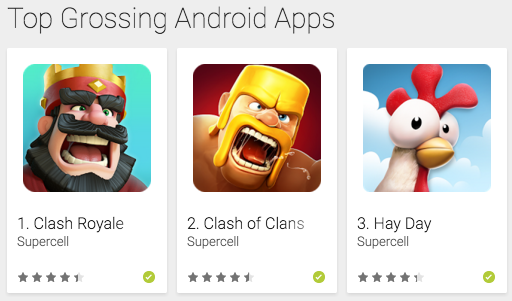
[caption id=“attachment_2795” align=“aligncenter” width=“300”]Pay to Win games make casual gaming futile Pay to Win games make casual gaming futile[/caption] Several years ago a friend told me about Clash of Clans and I began to play the game. The game is an enjoyable distraction for when you have a minute or two three. You perform a few actions and then you get on with your other tasks. When you play for free patience is an asset. You have to wait to get enough gold, elixir or gems before you can complete certain actions. The game is designed in such a way that you can play for years and still progress. I like to joke that the Pay  to Win model is both encouraging and training people to bribe their way through life. If you’re impatient you pay a little supplement and you complete the action. Instead of taking a week for an action to be completed it takes seconds. Supercell has made millions this way as individuals spend more than a thousand euros. Those who are willing to pay get to the top of the leaderboard.

Bragi - self contained in ear audio player

BRAGI - The Dash – Wireless Smart In Ear Headphones from BRAGI on Vimeo. I enjoy cycling, running, climbing and via Ferrata so this type of device is well suited to my needs. The price is not. At 300 USD it is an iPod shuffle replacement at its core. From what I understand The Dash can track steps, heart rate and duration of sports so in theory you can go without a sports watch, sports tracker or mobile phone. In practice, I never leave the house without my phone. I do see it filling a swimming niche. Most mobile phones are not IP68 certified. If this device is IP 68 certified (I could not find information on the website) then I see it being especially interesting for swimmers. According to their website they can be used for four hours in between charges but charge time is two hours. They will last through most workouts. The limitations I see to this device are first and foremost the price. I don’t want to pay 300 USD for something that I am likely to lose. I listen to podcasts and audio books and like to have several on my devices at all times. Both my mobile phone and iPod classic fill these roles with ease. When the price for these devices descends to 200 USD I will be willing to buy a set. I would also like to have either two sets of earphones or a charge time of just an hour rather than two. They say that the app is coming soon. As an audiobook and podcast listener, I want to save my progress and bookmark interesting passages. I would like to see this incorporated to the gestures that control the device.

Cycling with the Cateye Stealth Evo+

I bought the Cateye Stealth Evo+ a few weeks ago because this summer I am rediscovering my passion for cycling. I made this decision because the Suunto Ambit 3 is not optimised for cycling. I wanted to have a way of checking my cadence whilst at the same time having a GPS track and easy data transfer with a service such as Strava.

Price

I chose the Cateye Stealth Evo+ because of it’s wireless technology and price. I saw that the Garmin 500, 510 etc were offering all the same features but at a slightly higher price.

The Fitbit Charge HR

Best Fitness Tracker - Nov 4, 2016

Fitbit also good fitness tracker. It’s a kind of fitness tracker i have seen. Longibility battery performance. It show us Heartbeat and blood pulse. That’s why we can take next step of our health fitness. Fitbit is good. It also a Best Fitness Tracker to good to best useable tracker. Wish you Best health fitness.

The Fitbit Charge HR

The Fitbit Charge HR is one of the better heart rate and step counting solutions out at the moment. It allows you to keep track of your steps and heart rate twenty four hours a day for a little less than a week between charges. It is a wrist worn activity tracker that detects whether you are walking, running or climbing up a hill. I tested it over a period of weeks while hiking, doing via ferrata, cycling and sleeping. As a result of the test environment I was informed by the device that I had gone up 250+ floors in a single day. That’s when I was playing on a via ferrata or two. I also tested it while I was sleeping. It automatically goes in to sleep mode so there is no chance of you forgetting. As it tracked my heart rate while I was sleeping I saw that my resting heart rate could be 47 beats per minute. As I challenged myself with a 1000m hill climb on a bike followed by via ferrata and hiking my body became fatigued and this was reflected in my higher resting heart rate. It went up by four or five heart beats per minute. When I was using the Fitbit Charge HR I had it automatically tracking my heart rate but you can choose whether it is on/off or automatic. I kept it on automatic. When you take off the tracker the two green led lights stop blinking automatically after a few seconds. I liked having the Fitbit Charge HR for a few weeks and liked that it tracked my heart rate and showed me how many floors I went up. As I spend a lot of time in the mountains though the results were skewed. The biggest weakness with the Fitbit Charge HR has to do with the regionalisation efforts by Fitbit. I live in Switzerland and until recently I had the site in English. For a few weeks I have had to switch languages between french and English several times. I wrote a tweet to get a response but they asked me to send an e-mail. I sent an e-mail detailing the problem and then they asked me to detail what the problem was. The problem is that I am in the French speaking part of Switzerland, my laptop and phone are set to English and the app and website default to German. Due to their regionalisation efforts when I sold the device as planned I did not replace it and went back to using the Fitbit flex. As both straps for the Fitbit flex broke I carry the sensor in my pocket. As a point of reference my primary fitness tracker is the Suunto Ambit 3. When I cycle, swim, do via ferratas or hike that is the device that is tracking my progress and overall fitness level. I also pair it with Strava.

TomTom Go and the diminishing cost of live traffic data when driving

Today with Tomtom Go you pay 20CHF per year for the maps and traffic information. When I first bought the TomTom Europe apps for iOS and Android they cost about 170CHF an operating system. If my memory serves me well traffic information would cost an additional 100 CHF per year. As a result of the high cost for traffic information I was in the habit of using Waze. As long as you have a data connection you get maps and traffic information for free. It would save you 270 CHF initially. When you live in the french speaking part of Switzerland you are just minutes from France and within hours you can be in Germany, Austria and Italy. As a result having maps pre-loaded in to your navigation is useful. That’s where Tomtom at 20CHF per year becomes interesting. The maps available are for individual countries, for Western, Europe, Eastern Europe, the whole of Europe, The Caribbean, North America and South America. Each of these maps can be downloaded ahead of a trip and used. This means that once you’ve paid your 20 CHF you have maps for the world, not just for your daily commute. I am so convinced by Tomtom’s new philosophy that I have uninstalled Waze and will now use Tomtom primarily and Google maps as a backup.

The Crosscall Odyssey Plus

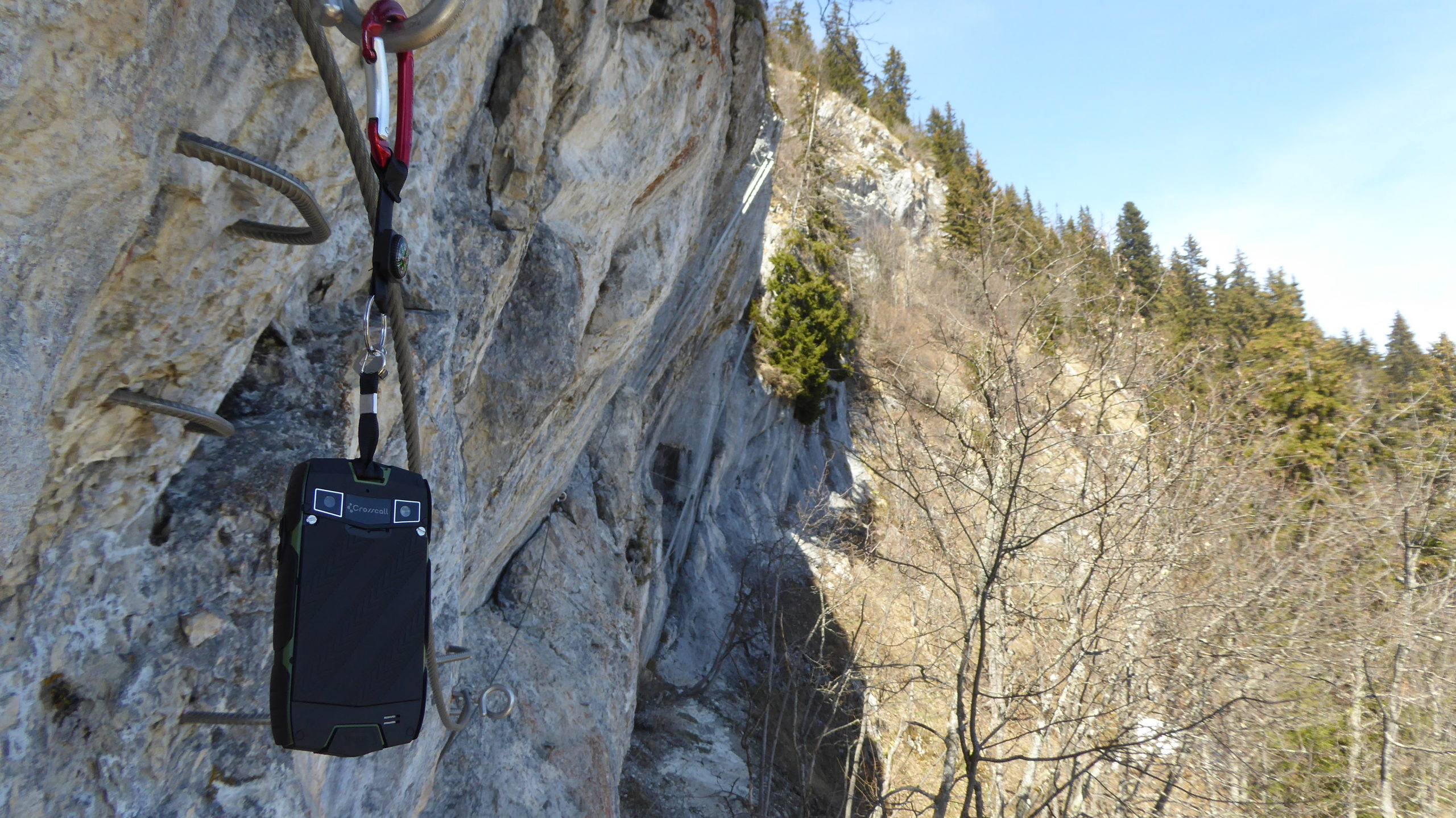
  The Crosscall Odyssey Plus fills two niches. It is a rugged weather proof phone rated to the IP 68 standard and is equipped with dual sim capability. This makes it ideal for the sports I enjoy, mainly via ferrata as pictured below and hiking. It comes with a smaller carabiner than the one pictured below. I swapped it for one of my own. 1030283 IP 68 is a code to determine how resistant a device is to both particulate matter and liquids. 6 denotes that the device is dust tight so particulate matter will not make it’s way in. 8 as defined by the manufacturer denotes that this device can be submerged for half an hour at 1m before damage occurs. If you get caught in the rain or have to cross a river the phone should survive. Another interesting feature is the dual sim capability. This phone allows for two microsims to be used at once. In my case I have a Swiss sim card and a french one. Both sims are constantly active so you can select whether to make phone calls from Sim 1 or Sim 2. You can also select which sim card is using the data plan. It runs android 4.3 and works fine with the TomTom app, the ingress and others. I found that battery life is also comfortable. With me as a user the battery lasts for a day. more info

The Apple Watch does not fill a niche

The Apple Watch rather than fill a niche provides a fifth screen. According to Wikipedia the four first screens are the cinema screen, the television screen and the mobile phone and tablet screen. The fifth screen is the smart watch as designed by Apple, Samsung, Sony and others. Apple and others have designed phones that bring the mobile phone experience to the wrist. Energy efficient Suunto, Garmin, Fitbit and other brands fill the wrist worn niche effectively because they have designed devices with energy efficient displays that provide tracking whilst at the same time giving extended battery life. Extended battery life in use Health trackers by fitbit and other companies have been designed to last for a week or more whilst tracking movement 24 hours a day. Suunto, Garmin and other brands have designed watches that can track activities for hours or even days before they need charging. Long stand by time When not in use all of the devices mentioned above can last for weeks. In the case of the Suunto Ambit two I have found that it loses one percentage of charge per day. As a result of this it can be used as a watch for three months before I need to think of charging. Data analysis All of these tools are for collecting data about the route you took, the intensity of the exercise tracked, heart rate and complementary information. When synced on the computer or website a lot of information is presented. Garmin syncs with Runkeeper, Strava, Garmin connect and other services, Suunto syncs with Movescount and Strava intuitively. Fitbit syncs with the fitbit site and other fitness apps. The most interesting data is analysed on a computer rather than the wrist unit. This leaves the device to track information cost effectively, where cost is battery life, and effective is defined by how long you can track an activity. Conclusion: My passion for “smart watches” stems from scuba diving. I bought a Suunto D9 to track dives and loved taking dive data and analysing it in view of improving my diving ability. I tracked training at the gym, hiking and other activities with various phones and their weakness was battery life. When you go for a hike in the mountains, go for a via ferrata or do a number of other sporting activities for extended periods of time you want a device that can last as long as you do. Suunto’s Ambit 2 filled that need very well, so well that I upgraded to the Suunto Ambit 3. As an android user I can’t  take advantage of all the features yet but that will come soon, this month in fact. The Apple Watch does not fill any of the requirements I have listed above and for this reason I am not tempted. I see it as a fifth screen that does not fill a niche. Fitness trackers, fitness watches and other devices cost the same price or less and fill niche requirements effectively. Why would I want a gimmick?
Tourism and Ingress

If you’re a geek and you like mobile phones with a data plan then ingress is for you. Over the last two days I walked 18 kilometres playing ingress and winning back the City of Nyon for the Resistance. It didn’t last long. The same evening the enlightened players destroyed my hard work. I will just have to go back and liberate the city later. I have more important tasks this weekend. Tomorrow Ingress FS Neuchatel will take place. At least twenty of us will be playing, walking around the city, looking for portals and trying to take over the city. Staring at a phone while walking around a city may sound counterintuitive, or absolutely normal for those who still use text messaging apps or tweet. In this case though you discover details of cities that you would not notice. You notice plaques, the names of places which you always walk by but never knew about and more. Playing the game has two parts. Attack and defence is one part and farming the second. Attack and defence are good because they don’t require much walking around. They just require having a lot of “toys” to play with. The drawback to having a lot of toys to play with is that you probably walked around like I did going from portal to portal and hacking it. You get weapons, modules, resonators and more. They are good for game play. There is a cultural aspect to farming. Missions designed by L9 players of ingress have portals related to a certain theme. If you walk in the old town of Geneva you can follow the Calvin track, the park brunswick mission or the Geneve, around the Cathedral mission. There is a good chance that you will know some of the monuments and you will discover others. With each portal players can write a description. These descriptions can provide you with a new understanding of the places you pass by. In essence it could serve as a guide book for those who like to see things in a different light.

Rome's Lost Empire

Documentaries have been a passion of mine for as long as I can remember. This year I started with the Documentary Rome’s Lost Empire narrated by Dan Snow. With Sarah, an associate professor they travel from Rome to Transylvania, to Petra and to Tunisia to uncover the Roman Frontier. Using a mixture of both satellite and Lidar imagery they are able to identify archeological sites before going to them in person. The documentary provided me with a greater understanding of how technology helps archeologists today to do their job and to provide me with information about aspects of Roman Civilisation that I had not spent too much time thinking about. For this reason I recommend that you watch the documentary.