Social Networking

The Dumbing Down of mainstream media

Recently I have found mainstream anglo-saxon media much harder to tolerate. A few years ago I went to see 90 films in 9 months. I had no TV and the World Wide Web wasn’t quite as accessible then as it is today. For years I could watch BBC World from the moment I woke up to the moment I went to sleep. I also read articles and blog posts. I can’t stand the hollywood film output anymore. They are so comfortable with their formulas that within ten minutes I knew the plot line. I used to read dozens of newspapers a day and dozens of blog posts a day. I noticed that blog posts started to become formulaic and so stopped reading blog after blog. The quality of content went down at the same time as output went up. Every blog post was a Top Ten article. Newspaper headlines used to provide the audience with information about what the article was about. You’d read the headline, skim the first paragraph and decide what to read next. As Social media became socially acceptable for growing portions of society so we see the decline in headline usefulness. Headlines should answer the who, what where, when, why how questions and engage you as a reader. The Guardian, the BBC, The Independent and other news sources rather than writing headlines about the content of articles write sensationalist headlines that are designed to blackmail you in to clicking a link. Usually the articles hidden behind these headlines are a waste of time. They provide little of value and they assume ignorance of current affairs. We live in the information age. Within 15 seconds whether you’re sitting at the top of a via ferrata or in a library you can get information on any topic that interests you. Remember that the web is the hypertext markup language. When you write today you can add links to help contextualise the story, you can provide videos and pictures. You can also write in as much depth as you would like. In the information age I would have liked, and I would have expected that writing would become more demanding. Knowledge would be assumed and context would be easy to provide. When background information is a search engine result away it would be logical to assume that experts and writers could write as if we, the lay reader, were also experts. Look at the way the refugee crisis is covered. We see terms like “thousands drown in sea” “Fortress Europe should let in more refugees” and many more phrases. These phrases do nothing to inform and educate the audience. They are only entertaining us. They are encouraging prejudice and stereotypes rather than discourse. With unlimited bandwidth, time and space the topic of refugees and migrants could be covered in great depth. Documentaries could be produced to provide context as to why people are pushed from where they lived. Xenophobia is a result of over-simplification. Imagine that tomorrow when you wake up you see François Hollande or David Cameron in Calais speaking with refugees. What effect would that have on the national debates of migration? We see ourselves as liberals and we see ourselves as citizens of the world. Why, as citizens of the world do we never see our leaders visit refugees? Let’s forget the status quo and let’s go for a contextualised actuality. (Actuality, Actualité, french for news. I chose not to use the stigmatised word Reality). Another example of the dumbing down is the TWIT network. I used to love listening to those podcasts. I would listen to at least five or six of their programs a week. TWIT, Macbreak weekly and others. I started to lose interest when they switched to video and my interest decayed completely by the time it was more chit chat than news. Editing gave their shows value. Without editing you’re wasting an hour and a half of listening time. Media production and advertising revenue is based on the “Lowest Common Denominator” theory. The simpler content is to understand the more views it will get. The more views it gets the more valuable it is. When media assets are owned by the financial sector and when giving dividends to share holders is more important than value to costumers so you get the erosion of quality. This erosion in quality means chasing a greater number of eyeballs with an ever decreasing quality of content. The Guardian, the BBC and other “mainstream media” companies have fallen in to the trap. They don’t need the money, they’re subsidised, but they need the eyeballs to justify their funding nonetheless. If the mainstream media want to destroy themselves then that’s fine. In theory. In practice this leaches in to the social media landscape. As an early adopter I join social networks and social media distribution platforms in their early days, when the intellectual, entrepreneurial and curious people are around. Conversations and friendships make empty social networks look and feel lively. As users engage stickiness grows. As stickiness increases so value increases. Look at Twitter and Facebook as prime examples. Twitter was a fantastic conversation tool in it’s early days, so fantastic that for the first time in a social network I would meet with users every week at it’s peak. Facebook was a uni friend network. We had all partied together and as we knew each other well we could be open and social in a closed network. When advertisers, social media gremlins and PR professionals came in to these landscapes so the conversation chased the rabbit down the hole of the lowest common denominator. Conversations diluted and friendships decayed to the point where trolling became standard. The dumbing down of the mainstream media led to the decline in sociability and friendliness on social networks at a time when social media became mainstream. As a positive last thought everything is cyclical. We will see mainstream media smarten up again. We will go back to long form articles, and we will go back to interesting film plots.

On the lack of Common interests and mobile phones getting the blame

On Linkedin and Facebook people believe that mobile phones are making people less sociable then they would be if phones were not around. They believe that the world in which we lived before mobile phones was an open and sociable place where everyone communicated with everyone. These people are forgetting the social context that brought them Home Alone, Problem Child and other films. Society and social interactions have always been about finding the people whom you appreciate and those whom you prefer to keep away from. In the age before mobile phones I remember watching films and cartoons where certain characters were ostracised for being different. These people were seen as isolated or loners. Society does not like these people. We see it conversation and we see it in films. If a group of people in the physical world does not want to spend time with you, does not want to listen to you because your passions are incompatible with theirs, because your tone of voice is not right then that is their right. These people though, are not satisfied with excluding you from their conversations, are not satisfied with having their monologues and showing no interest in you. They will go a step further. They will prevent you from entertaining yourself. One of the most common forms of entertainment when people are not fully engaged with groups is the mobile phone. Mobile phone use is stigmatised by a lot of people. Just a few weeks ago I took a chance and met with a new group. As I am an ingress player and as I had nothing positive to add to the conversation I took the opportunity to farm from two portals that were in range. As I live in the countryside Ingress “farming” is a treat and I took advantage of the opportunity. I was listening to the conversations taking place on both sides of me. On one side it was the stereotypical “What do you do?” International community conversation and on the other they were discussing a few topics. One of these topics was music festivals. I have had a lot of fun at music festivals but I also have some views that I share with facebook friends rather than the wider world as it would see me ostracised. As I drove home from the meeting above I got a text message and felt that it would be bad. I read it when I got home and left the group. I won’t be told how to behave by strangers. I won’t be judged in a town by a group of people who hike and do via ferrata. If you participate in both of these sports there is a good chance that you will appreciate my company. When I am in the mountains one of the cameras I carry around is out but my mobile phone is in a pocket until I get to the end of the activity or the car. I am a member of the Geneva Ingress Resistance as well as the Lausanne Ingress resistance. As a result of this I have access via Google Hangouts to at least 120 people in the Lac Léman (lake Geneva) region. These people are unique. What makes them stand out is that they’re always looking at their mobile phones and when you see the entire group is silent it’s because they’re “glyphing”. I like to spend time with these groups because we eat crisps, drink wine, eat ice creams, hike and do other activities. These people meet because of the game but you see that there are deep friendships that have benefited from mobile phone use. I love the paradox. The paradox is as follows. Every user is in the Google Plus community, every user converses with other players in Google Hangouts and every player meets other players in the real world. The mobile phone is a link between those who are not present and those who are present. In effect whether you converse with these people from a computer, by mobile phone or in person changes little. Last week at the end of one operation to field over Yverdon with blue fields and another operation to field another city a phone call was made via google hangouts and we all answered and put the phones to our heads for a conference call. Instead of the mobile phone isolating people it is doing the opposite. It is uniting people. Look at the conventional social interaction. When two normal people call each other the people you’re with are isolated for a period of time. It’s the same when people in face to face conversations start talking about mutual friends, certain types of activities and more. Sometimes the conversation that two conventional people are having is more likely to isolate the people you’re in the same physical location with. More often than not small talk is frustrating because A) you don’t know whom they’re talking about and B) you don’t know the context. As a result small talk is less polite than mobile phone use. I love the mountains and I enjoy via ferrata and hiking when it’s with the right people. I also enjoy spending time with ingress players. With these three groups of people I feel that I can be myself. I spend no time acting and performing. They appreciate the real me.  When I go to towns and listen to normal people small talk I get bored and I feel isolated. It has nothing to do with the mobile phone and everything to do with the difference in interests and passions. If we don’t have the same interests and passions then don’t blame mobile phones for our lack of conversation. Either we find something we are both passionate about or we co-exist in the same space without talking much… Sometimes the inability for people to accept silence when they are not alone encourages others to be alone.

Social networks and project collaboration

Jacques Yves Cousteau’s documentaries would have done well in the social media age, especially if the social media age moved away from profit and money. Imagine that social media companies such as Facebook and twitter were Not For Profit Organisations and imagine that instead of having advertisers they had sponsors. The quality of content and discussion would increase and the time wasting element that so many people worry about would be gone. Alexandra Cousteau, grand daughter of Jacques Yves Cousteau is on twitter and she shares articles related to conservation and related topics. Not for profit organisations such as MSF and UN organisations such as the United Nations Development program all share content and articles that provide their followers with valuable resources for bringing conversations forward. Social networks should be seen as anything but a waste of time. Their purpose would be to find clients, to find collaborators and to find mentors. In having these three resources finding new projects, employment and collaboration opportunities would increase. We would eliminate viral videos, tabloid content and keep high value, high return on investment prospects. Rather than PR and marketing specialists flooding our timelines with emotional but useless content we would have high value content worth responding too. The aim would be to demonstrate our strengths in a high brow environment where conversations are possible and encouraged. From the time I was ten years old I have lived in the international community, between school, where I worked, university and more. As a result friends are distributed around the world rather than driving distance. Imagine that this network stopped seeing social networks as tabloid as commercial and a waste of time and instead saw them as useful work tools. For me this is nothing new. When I was in London when twitter was in it’s infancy and when facebook too was in it’s infancy I saw both social networks as networking tools. I met hundreds of people via both networks and I continue to do this today but at a less efficient pace than I would like. The aim would be that for every four or five days of social media use I would get two or three in person meetings with people to discuss projects and collaborations. I would also like to be inspired and encouraged to work on specific projects. The Game Ingress by Niantic labs is a perfect example of what I would like to see within a professional context. Through the game Ingress I have met people in Paris, Fribourg, Lausanne and Geneva to mention just a few. If I go to Paris on the 22nd I can meet agents. If I follow mission days or First Saturdays then I can meet people in a number of cities. I mention this because although ingress is not a professional network it is still a project network. It requires geographically based teams to collaborate to achieve goals. If we could distribute that kind of network for documentary production and collaboration then employability and familiarity would both benefit. It’s a shame that with all of the communication tools we have today we see social networks such as facebook and twitter as PR and marketing tools rather than collaboration and relationship tools. I have web designers, musicians, camera operators, writers, journalists, photographers, fundraisers, financial analysts and digital analysts as friends on Facebook and yet it is hard to see what people are working on. Imagine social networks that are optimised to benefit from your existing network.

Fribourg was liberated by Fribourg, Lausanne and Geneva Ingress resistance fighters

This weekend teams of Resistance Ingress agents from Fribourg, Lausanne and Geneva met in Fribourg to neutralise and capture all Enlightened portals. Some teams were on foot to liberate portals from the centre of the city. I was with the bike team and we took care of liberating all of the portals on the outskirts. It involved cycling up and down hills, a thunderstorm and being rained on. I really enjoyed being part of the cycling team. It’s a fantastic way to get around and it’s a good way of seeing a big portion of unfamiliar cities with a minimum of effort. My team members were on electric bikes and I was on a mountain bike. This was great for me. I had to work hard to keep up with them. This was a good workout. There were moments where I generated up to an estimated 1300 watts of power for very short bursts and got the fifth best time on a segment. I enjoyed this experience so much that I would love to do this again in other cities around here. Cycling gave me a workout and playing Ingress gave me time to recover. It seems that if you’re creating fields having a bike is ideal. You can get almost anywhere from anywhere within a city within minutes with a minimum of effort. By car this would be dangerous and impractical and on foot it would be slow and impractical.

The Lowest Common Denominator

When animated gifs were new and overused on geocities they were tiring. They were used by people whose homes are surely filled with kitsch. Facebook, with it’s declining user engagement decided that it would join the “me too” bandwagon. As a result of this we will see a noisier unsociable feed. Twitter has made retweets confusing today. When something is retweeted or commented on you want to see the relevant tweet with the comment. As retweets are today we see a comment and a hyperlink. That comment and hyperlink are useless as they require you to click through to understand. In some circles this would be seen as spam. Users must always know where the link they are clicking is taking them. I look forward to finding conversation sites where user interactions are the reason for the network to be in existence. At the moment too many “social networks” have encouraged spammy behaviour rather than conversation. As the social networks are filled with junk so the statement that “social media websites are a waste of time” is being made clearer every day.

Video piracy in the 21st century

A few days ago I was watching a Magnum PI episode where Higgins had a film camera pointed at the television screen to record a game of snooker broadcast from “half way around the world” by satellite.  Today I noticed this article speaking of the way in which twitter’s Periscope app and Meerkat were used to pirate a fight. Piracy is nothing new but the simplicity with which people can pirate and share content has evolved. Piracy required rolls of films at first. These rolls had to be developed and then copies had to be made. This could take several days. VHS came along and made it easier. With several VHS decks you could make several copies at once. Steve Jobs is well known for the boot leg tapes he had of music concerts. My generation streamed live music concerts using mobile phones. Football enthusiasts used satellite receivers and streaming software to re-distribute live football matches years ago. This is true both for european Football and American football. The live streaming of broadcast content is now so simple that multiple people, using social media, redistribute content as it happens. There is no lag time. There is no exclusivity possible. PeriscopeTV and Meerkat have made it very simple to share live events circumventing the gate keepers. Gate keepers provide the highest audio and video quality possible for their customers and for this reason they are safe for now. The pirated copy has low video and audio quality and is filmed by a mobile phone camera. Social networks such as Twitter and sporting organisations will need to strengthen their collaboration. Both of them can and will benefit from joining forces. If PeriscopeTV and Meerkat both get paid by the Fight promoters to carry the signal as premium content then the pirate streams will be of less interest. Price will have to reflect the platform on which content is being shared of course.

is twitter changing your blogging habits? - A 2008 response

Yes and no. Twitter is replacing instant messaging and chatrooms. It’s an open method by which for people to communicate instantly with others. It’s also about the overheard conversation although that term has disappeared. What does “overheard” mean? Well simply that whenever two people discuss a topic hundreds of people are following this conversation and when they decide they have an opinion they can cut in. They do have that 140 character limit though, so they need to get to the point is efficiently as possible. When that isn’t possible then they can do the next best thing. Write a comment in a blog post or even write a blog entry of their own where the conversation that took place on twitter is synthesised into a more digestible chunk of information. As a result twitter is changing people’s blogging habits but the question is why people want to chat publicly rather than in an enclosed space. Today people like transparency. Disclaimer: This is a post from the 28th of Octobre 2008. An unpublished post

Pride and media consumption

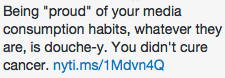
I enjoyed reading the Unbearable Lightness of Being so much that I read every book by Milan Kundera. I also read every book by Albert Camus because I enjoyed reading La Peste so much. Laura M. Holson wrote an article about “Unplugging without FOMO” which I skimmed after someone on twitter commented on twitter that Screen Shot 2015-03-29 at 18.45.06 and I strongly disagree with this person’s view. It brings us to the conversation about high and low culture. I take the view that media consumption should be focused on high culture. For my dissertation I watched hundreds of documentaries. I watched every David Attenborough documentary, every Jacques Yves Cousteau documentary. I read many books and articles on the topic of the documentary genre and as a result I take pride in the knowledge that I have acquired in the process. When I skimmed through the article I saw that the discussions were about low culture, about tabloid topics. They speak about things that I would never discuss as they are of no importance or interest. These are things that have no effect on my quality of life. At the same time I do feel the usual regret. Mid to late adopters came to social media, made it tabloid and then complain about the stream which they and their friends generated. In my childhood I read encyclopedia articles during breakfast, as a teen I spent hours in computer rooms learning about webmastering and search engine optimisation before others were interested. I was experimenting with video compression tools in the late 1990s and gained a deep understanding of the tools that would lead from new media to social media. The conversations were about culture and people took a constructive attitude. From 2009 onwards I saw the shift away from personal conversations between friends to the hunt for followers and the loss of the personal connection and I blogged about it. As I went back to read the article about unplugging so I see a reaction to what I have been saying for years now. Articles are being written for people with no staying power. Social networks are becoming broadcast rather than exchange and the superficiality of the web is driving people away. I am happy that social media and microblogging are beyond their sell by date because it means that I can give time up to blogging once again. I can once again discuss topics that interest me in long form. It means that we will spend more time reading, more time learning once again. That is the beauty of the shift away from social media. In reality I have nothing to gain from participating in the Meme media. Même media, the Same media. The media where people use hashtags to be certain that they are in the flock, the flock of hashtag users rather than conversationalists. If I can’t converse I will have a monologue and people who are like minded will find me and we shall converse away from the madding crowd. Someday I will read that book. I love to read and I love to write. Today I am doing both as it’s raining outside. Screen Shot 2015-03-29 at 19.14.02

Social media, loneliness and isolation.

“The pathology of social media is all about loneliness” Social media professionals take the weekend off. Twitter users use hashtags so that their content can be found without being followed. Everything is turned towards discoverability rather than commitment and conversation. Social media practitioners know that people aren’t listening attentively so they repeat and repeat in the hope of a click or two. Hashtags are just a way of pretending that a conversation has had an audience. It doesn’t measure the number of comments and responses. It doesn’t measure how long threads lasted before they stopped. There was a time when people like me would read every tweet from people we followed and we would converse daily. It created a lot of friendships and led to a lot of face to face meetings. In today’s social media landscape I do see loneliness rather than socialising. I see on twitter that people are actively posting only once or twice a day. On Facebook I have seen such a serious decline in participation that there is little reason to stick around. My generation were active in social media for a short amount of time and now they have retreated to “normal” life. Whilst some people have hundreds of likes on their instagram images I have half a dozen to a dozen. Almost every like on Instagram is a person that I have conversed with online for years. There is a chance that I can tell you how long we’ve been chatting online, whether we’ve met in person and at what event and which networks we have shared. Twitter friends were trusted enough to become facebook friends. Facebook and twitter friends followed on instagram etc. Facebook was a very active and social place when we were all at university and having the same social life. Twitter was a very social network when I was looking for work and meeting the London Social Media crowd, the French social media crowd and the Swiss social media individuals. Ingress has presented me with a large group of Swiss people whom I have met many times recently as an active player of Ingress. Many of them are around my age.  We use Google hangouts to talk and plan missions and are in constant communication. Glocals was good for finding people to explore new activities and locations with but the connection lasted only as long as the activities. There was little to no follow up socialising online. The Glocals Scuba diving group is the one I got along with best and the group with which I did the most activities. It’s a shame that this was an activity for people a decade older than me. When I think of the social journey both online and offline I see that loneliness is not the pathology of social media. I joined Twitter because I love to try new things. Facebook was a network of university friends whom I saw every day. Seesmic was a network of people whom I developed strong friendships with that last to this day and Glocals was probably the only network I joined out of solitude and a need to do things on weekends. I like the irony that the network I joined to avoid solitude is the one that resulted in the deepest feeling of it. Eventually every social network becomes lonely but we would say the same about the city from which our friends have gone, of the bars and more. Geneva is referred to as an airport hub. People come to the city for a year or two and then leave. As a result the refreshing of friendships is very high and it takes a certain personality to cope. Modern transportation; planes, cars, and trains create a pathology of loneliness and social media are part of the solution for as long as the social networks are frequented.