Conversations

Social Media and The Human Return on Investment

Social Media and the Human Return on Investment, because contrary to popular belief we use social networks to socialise, not to shop. As we grow older and more mature our close network of friends changes and evolves. We go from school friends to university friends and then to professional friends. In the process we move from a village to another village, from a town to another town and eventually from one city to another. In the process the links we have with some friends strengthen and others degrade over time. This is modern life. I find it hard to discern whether the return on time invested on social networks like Twitter, Facebook, Google+ and others is decreasing because people’s understanding of these social networks is shifting or whether it is related to growing up. As the people I know get married and have children their priorities change and privacy becomes more important. We have to keep the children safe. Facebook, as a social network is less engaging than it used to be. The people I have as friends post less frequently, the events we can participate in together is shifting and the content shown in timelines is evolving. To compensate for the decline in friends engaging in social networks like twitter and Facebook people are following publications, brands and news sources. This flow of information is tailored to the lowest common denominator. The sensationalist writing style discourages me from following these sources of information. I have a concern that what were social networks until two or three years ago have become advertising networks on which people occasionally socialise and interact with other individuals. I feel that a bigger and bigger portion of the time that people spend on advertising networks is looking at mainstream content and comments. On Facebook as I scroll down the timeline I notice an increasing number of adverts. Personal posts are less and less frequent. Has the community left this “social” network? I have spent years thinking about online communities and how they interact. During this time I have seen the ebb and flow from one type of community to another across multiple platforms and applications. Within the next two to five years social networks will be virtual reality environments such as we saw with World of Warcraft, Everquest and Second Life. The question is whether people will want to socialise in virtual reality or whether it will be populated by gamers. Every online social network is stigmatised. This stigmatisation prevents people from fully exploiting the potential of social networks. We see this stigma through the use of dating apps rather than Twitter, Facebook, Google+ and other social networks. Dating apps are stigmatised but at least you swipe left or right and you’re done. ;-). You’re only “active” for a few seconds at a time. On Facebook and twitter you need to be active for hours, days, weeks or even months… You have to be careful. You may be stigmatised. ;-) Now that most people see social networks as a waste of time it gives us more time to do other things. It gives us time to read, to do research, to watch television and even to go two or three hours without looking at a mobile or computer screen. Imagine that. ;-) I believe that on the one hand the stigmatisation of Social networks as a waste of time has discouraged people from using them to their full potential. As a result of this people feel comfortable spending ten to fifteen minutes a day on these networks. On the other hand I see marketers, public relations specialists and advertisers push for their campaign to be seen. As peer to peer communication goes down and human return on investment (ROI) decreases, and as marketing campaigns take over the timelines they are effectively closing the door on people’s motivation to spend time reading through their timeline.
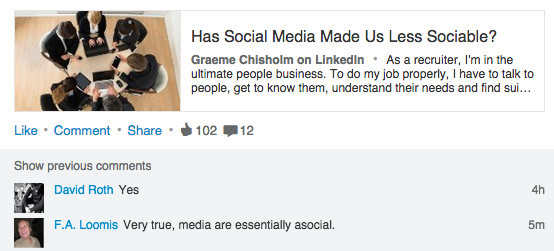
Has Social Media made us less sociable?

[caption id=“attachment_2438” align=“aligncenter” width=“554”]As an extrovert of course you’d believe this. As a mid to late adopter you’d also believe this. As an extrovert of course you’d believe this. As a mid to late adopter you’d also believe this.[/caption] Introverts who are not going to compete with extroverts, through social media, have an opportunity to have friendships and interactions that would otherwise not occur. To say that Social media makes is unsociable is a fallacy. When I was a uni student the second time around I was socialising with fellow students all throughout the day and I was also active in social media. In 2007-2009 facebook was my university friend network. Twitter was strangers. Facebook was an extension of my physical social life. Twitter was an opportunity to meet new people. It helped me meet people from tuttle. It introduced me to Seesmic when it was in Alpha. I conversed with some of the big names of the time and went to podcamps. I was invited to Leweb in Paris in 2009 and we met had seesmic meetups a number of times More recently playing Ingress by Niantic Labs has helped me meet people in Paris, lausanne, Fribourg, Geneva, Nyon and other places. To say that social media makes people less social is to ignore that people use social media for conversations, not for brands. The fallacy of most “social media professionals”, “Social media experts” and other “social media” snake oil practitioners is that they go home to a spouse or better half. They have no need to create a relationship with the people they are interacting with. As they do not create relationships with those who use social media they are kicking dust in the Atacama desert in the hope to raise enough dust to create a nucleus to which water will collect and fall as rain water. There is a shift in social media today. It is a shift away from conversations especially on websites such as twitter and facebook towards brand brainwashing. As a result of this facebook and twitter have lost engagement. That is not to say that other niche social networks are not benefiting from the ground broken by Facebook and twitter. In particular I am thinking of websites for slow ups and other group activities. I’m thinking of OVS (on vas sortir), Glocals (Geneva Locals) and many other social networks. I notice that the expatriated and international community benefit strongly from websites that encourage groups of people to do communal activities. Thanks to Glocals I scuba dived every single weekend for more than a year, I learned about Via Ferrata and loved the sport, I finally got to rock climb, I enjoyed canyoning and more. The idea that luddites can constantly bash social interactions via computers and electronic devices fatigues me. You know what the most amusing thing is about the people who say that social media reduces conversations is? Their one word answer. :-D. Don’t you just love the irony?

Threaded conversations and community

From the 1970s to 2007 we had threaded conversations through bulletin boards, forums, groups and other centralising discussion points. For a brief window of about two years conversations became so captivating that people wanted to meet in person as strong friendships were established. By 2009-2010 the threaded and personal conversations between web users was hijacked by “social media” marketers and so the speed of conversation and quality of interactions collapsed. In it’s place hashtags would replace user engagement with quick metrics. The golden age of conversation has been replaced by the dark ages of indifference. Every day that we spend online we see how disengaged people have become. Look at twitter. Do you still see user to user conversations. Look at Facebook. Do you still see engaging content and passionate conversations? I see a waste of time. The conversations which were taking place have been replaced by dumbed down headlines and sensationalist content. For several years we have heard about how corporations should not have access to our data because of what they will do with it. From where I am surfing the web and interacting with the online community I see a more serious problem. I see that as the chance of individual to individual conversations has decreased so the quality of shared articles, videos and other content has been dumbed down. This is evident on Facebook and Twitter. These networks are becoming ghost towns. They have millions of user profiles that are slowly going dormant. That social media networks are going dormant is excellent. Instead of wasting time with Ello, Diaspora and other solutions I believe that going back to the blogging habit will benefit everyone. It is decentralised, it is interest based and it is long form. Through Worpdress.org tools, through Disqus and other solutions so our ability to connect and communicate is improved. It forces us to be positive and to be accountable. Everything that you share can contribute to your reputation and help share your passions. We should not be hidden behind silos and we should not be anonymous. We need to break the twitter and Facebook duopoly.